



Why Conan the Barbarian (1982) Cast Bodybuilders and Surfers Instead of Actors
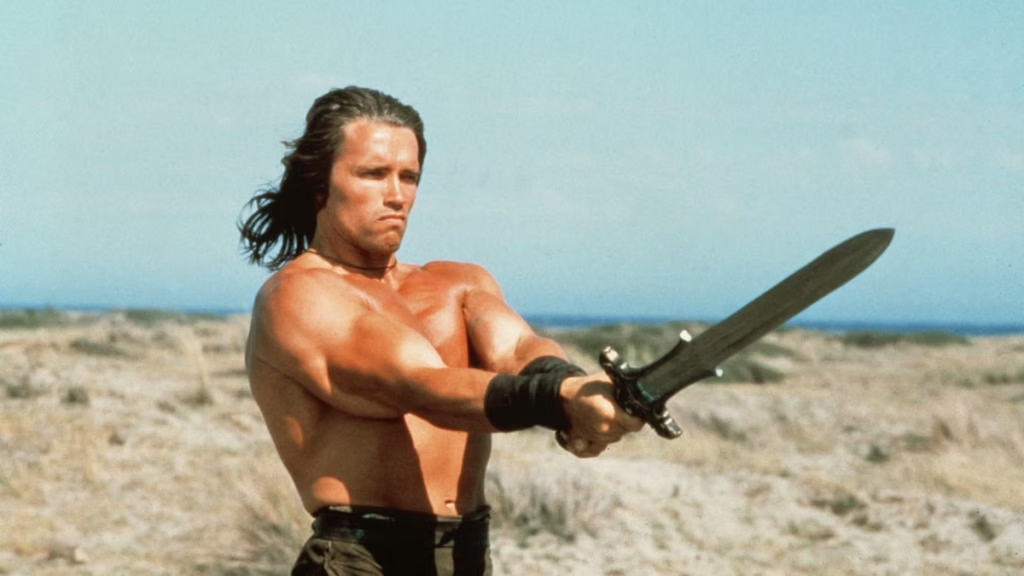
The 1982 Conan the Barbarian movie did not cast its lead because he could act. It cast him because no stunt double on earth could match his body, and no trained actor on earth could make a broadsword look like it belonged in his hands.
The same principle applied to every major role in the film. Director John Milius filled his cast with people who had never carried a dramatic scene in their lives, then rebuilt every other filmmaking decision around that choice. It was either the most reckless gamble in fantasy cinema or its most inspired.
And four decades later, no one has managed to replicate what it produced.
What makes this gamble worth examining is that every attempt to repeat it failed, and the reasons why trace back to something specific about the bodies in front of that camera and the single, towering exception Milius placed among them.
Why did Conan the Barbarian cast athletes instead of actors?
John Milius didn’t cast Conan the Barbarian the way Hollywood expected him to. He passed on trained actors, ignored agents’ shortlists, and populated his film with bodybuilders, surfers, and dancers, the types of people who had never carried a scene in their lives but who could carry a broadsword like they meant it. This was the film’s founding creative principle, and it’s the reason the 1982 Conan still feels like nothing else in the genre four decades later.
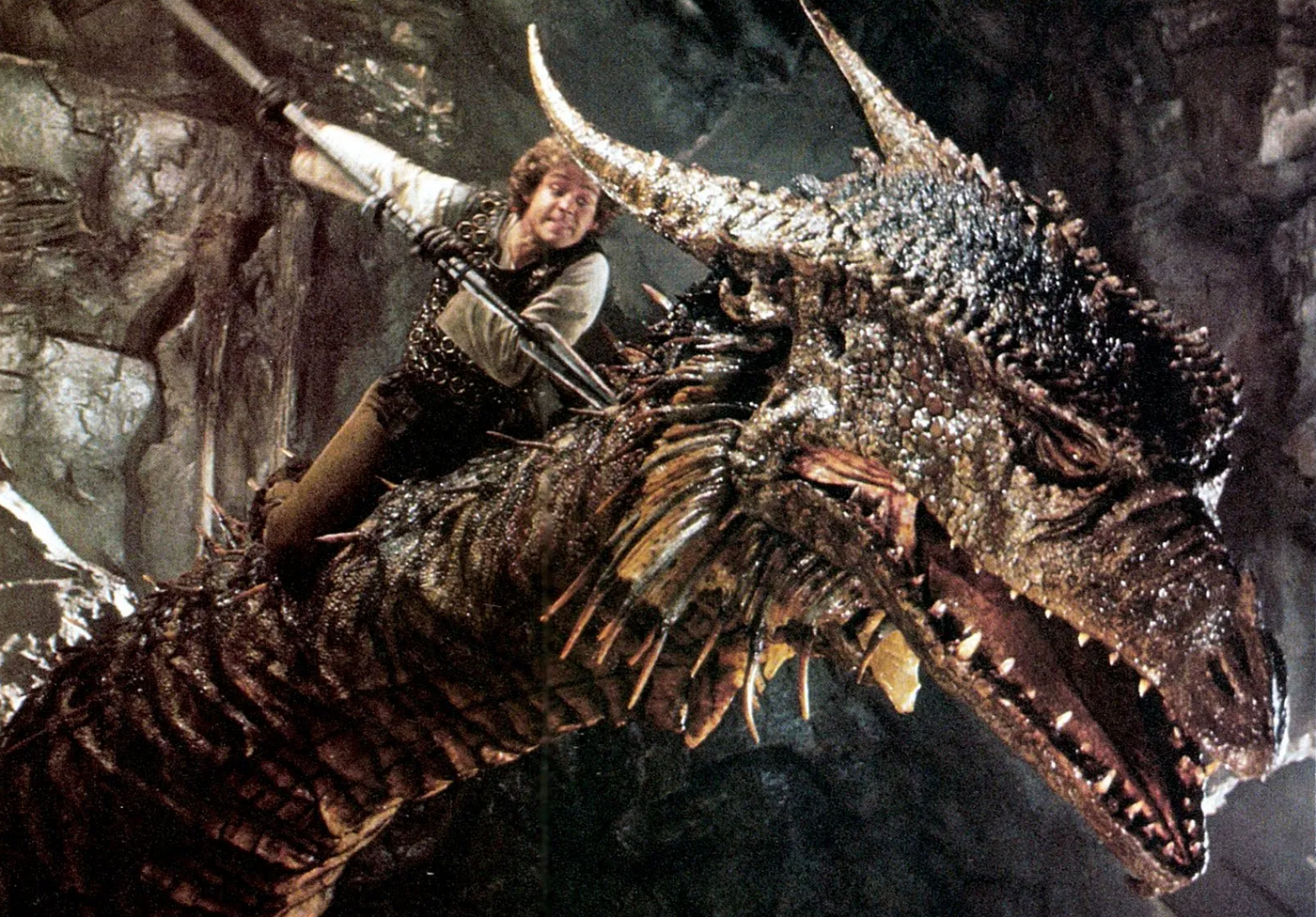
To understand why Milius’s approach was radical, consider what sword-and-sorcery looked like on screen before he got his hands on it: it didn’t, really. The genre Robert E. Howard invented in the 1930s had no functional cinematic template by 1980. What existed were failures. Hawk the Slayer, shot in Buckinghamshire on £600,000, paired a wooden lead with a synthesizer score and earned a cult following instead of an audience. Dragonslayer had Oscar-nominated practical effects and a genuinely menacing dragon courtesy of Industrial Light & Magic, and it still couldn’t compete at the box office or convince adults to take the genre seriously. Studios treated sword-and-sorcery as something to aim at the youngest possible demographic and spend as little as possible on.
Milius came from the opposite end of the creative spectrum. He was a USC film school graduate who’d written Apocalypse Now, co-written Dirty Harry, and directed The Wind and the Lion. He described himself as a “Zen anarchist” in one breath and a “right-wing extremist” in the next, and his vision for Conan fused samurai bushido with the Nietzschean Übermensch. When he described what he wanted in his cast, he said Conan “relies on the animal,” and that “the animal instincts are often the worst part of them. All you do when you evolve is corrupt yourself sooner or later.” He wanted performers who didn’t have to act tough because their bodies already knew what toughness cost.
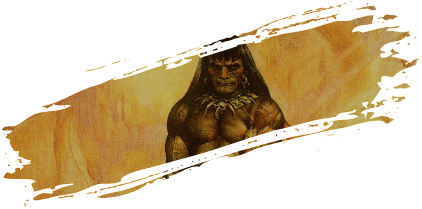
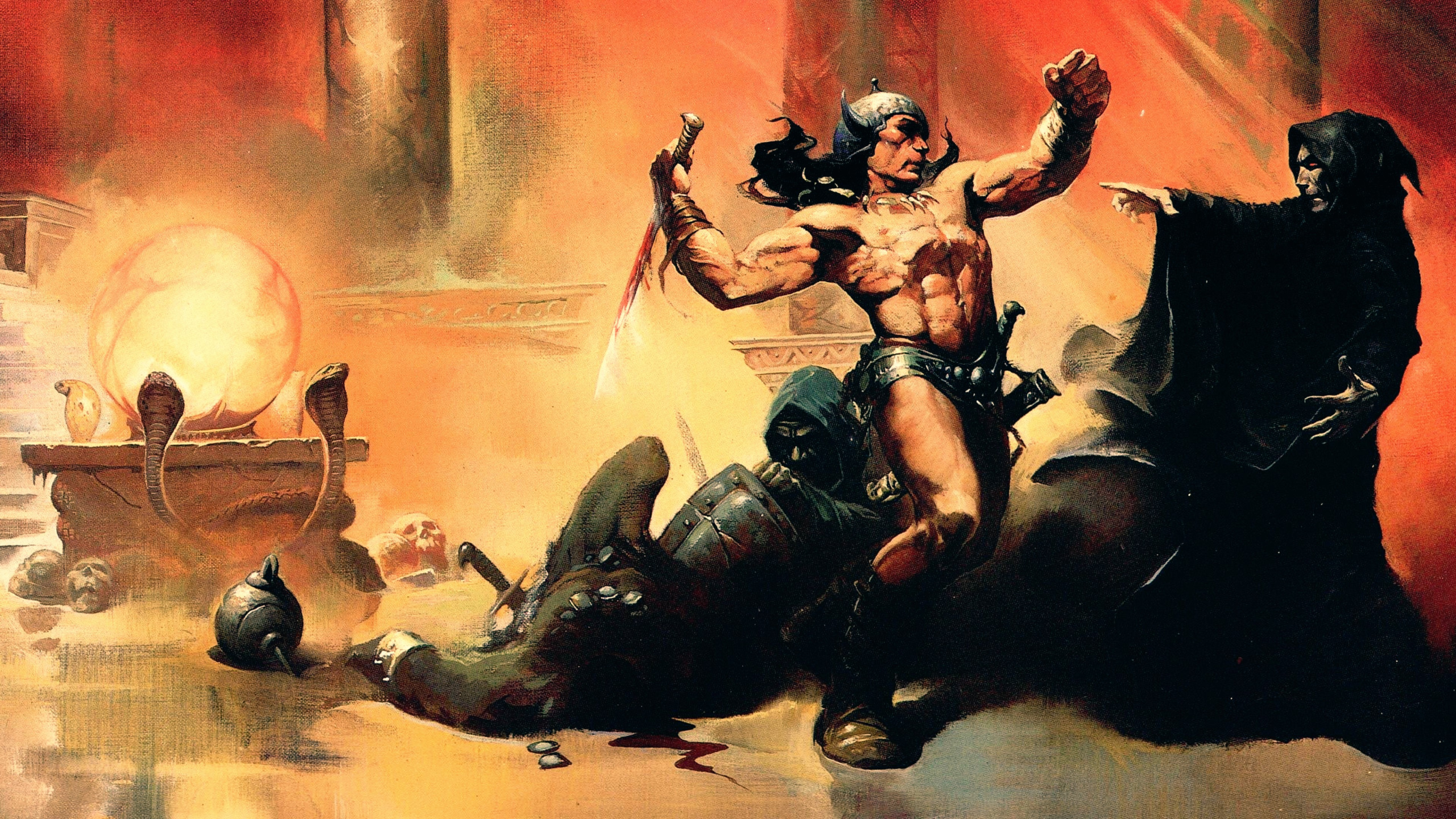
The producers had initially gone looking for exactly the kind of actor Milius didn’t want. Edward R. Pressman and Edward Summer evaluated men with proven screen presence and bankable toughness like Charles Bronson and Sylvester Stallone. Then, they watched a rough cut of Pumping Iron, and the search ended. None of the traditional candidates possessed the exaggerated, mythic musculature that Frank Frazetta had painted onto the Lancer paperback covers in the 1960s quite like Arnold Schwarzenegger.
Not everyone was convinced. Dino De Laurentiis, the veteran Italian producer who acquired the project in 1979, despised the Schwarzenegger casting from the start. The two had met previously during discussions about Flash Gordon, where Schwarzenegger looked at De Laurentiis’s enormous desk and asked, “Why does a little guy like you need such a big desk?” De Laurentiis considered the Austrian accent a fatal flaw and only relented because Schwarzenegger came as part of a preexisting package deal he couldn’t unwind. The producer and the director would clash on nearly every subsequent decision, but the casting fight established the pattern early: Milius had a vision that prioritized physical authenticity over commercial safety, and he was willing to burn relationships to protect it.
Who were the athletes and non-actors in the cast of Conan the Barbarian?
Arnold Schwarzenegger had won seven Mr. Olympia titles by the time he stepped onto the set in Spain. His casting was viewed by everyone in Hollywood as a novelty, not a serious display of acting–and Milius was counting on exactly that.
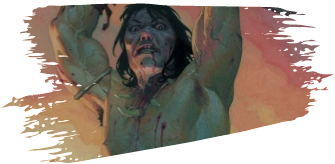
Because no stunt double on earth matched Schwarzenegger’s physique, he performed nearly all of his own stunts. Under swordmaster Kiyoshi Yamazaki, he drilled broadsword routines dozens of times before cameras rolled, learning to swing heavy steel the way a soldier would rather than the way a fencer might. He told Milius to treat him like a “trained dog,” and Milius obliged. Schwarzenegger was bitten by real pursuit dogs during chase sequences, took a deep gash to the head, and endured the physical reality of being lashed to the Tree of Woe. Where a traditional leading man would have handed these moments to a double and watched from a chair, Schwarzenegger bled for them. That difference is visible in every frame.
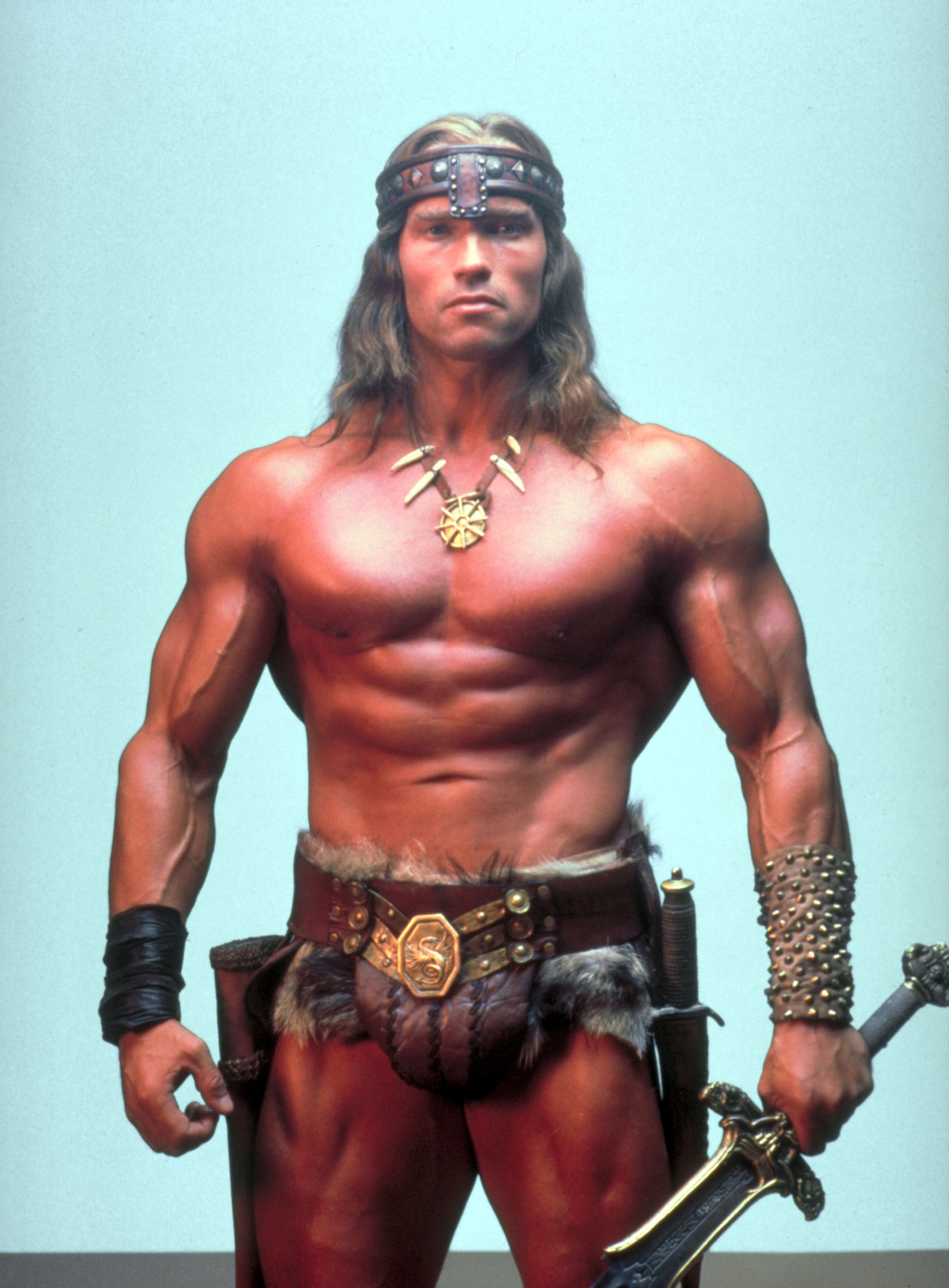
The production leaned into his limitations rather than hiding them. Oliver Stone’s original screenplay had carried a standard dialogue load. He calibrated it by having Schwarzenegger read aloud from Marvel’s Conan comics. Under Milius, those lines were progressively stripped away. Conan speaks nothing for the film’s first 22 minutes. He says five words to Valeria across the entire 129-minute runtime. This was partly pragmatic (less dialogue meant less accent) but it was also philosophical. Milius wanted Conan’s internal life carried by Basil Poledouris’s score and by the character’s physical reactions, not by speeches. The result is a protagonist who communicates the way an animal does: through posture, through action, through silence that feels loaded rather than empty.
Sandahl Bergman came from an entirely different discipline and arrived at the same destination. She had no dramatic acting background to speak of. What she had was a six-foot frame, elite spatial awareness honed through decades of choreography, and an understanding of rhythm and balance that most trained actors never develop. When she picked up a sword, it showed. Critics noted that her combat aptitude often exceeded Schwarzenegger’s, for her swordsmanship carried what reviewers described as a cat-like grace, a dangerous fluidity that made Valeria feel like a killer rather than a love interest holding a prop.
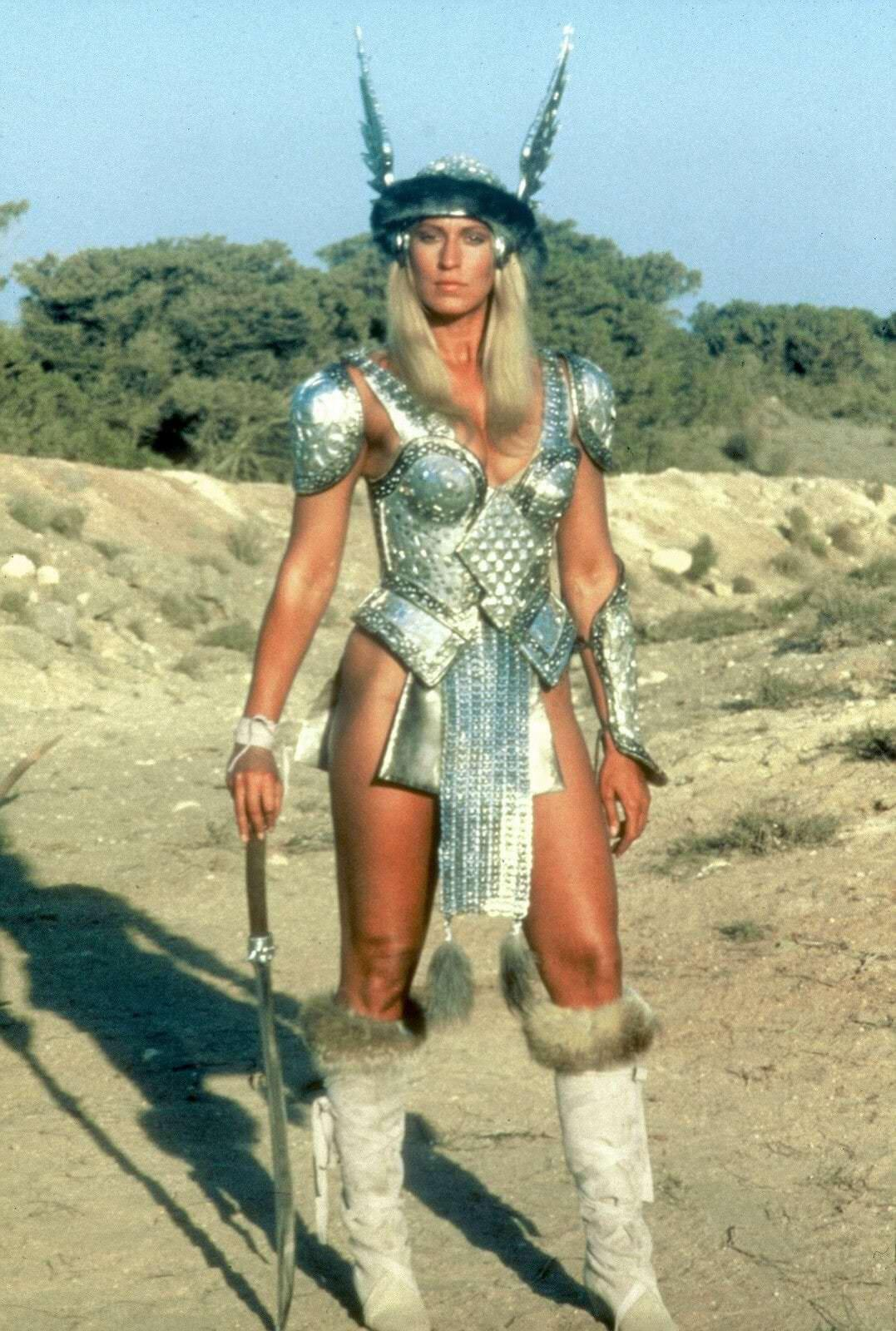
Bob Fosse himself recommended her for the role. Milius saw immediately what he needed: a woman with a “bruised, lived-in quality” and the “frank, gutsy beauty” of someone who was the “pilot of her own destiny.” Like Schwarzenegger, her physical size meant no stuntwoman could double for her, so she performed everything herself and nearly lost a finger during production. She won the Golden Globe for New Star of the Year, which is a polite way of saying the industry had no existing category for what she’d done.
If Bergman was an unlikely warrior, Gerry Lopez was an impossible one. Lopez was a legendary Hawaiian surfer, famous for his serene mastery of the Banzai Pipeline’s most dangerous waves. He also had zero acting experience. His connection to the production was pure friendship: he and Milius had bonded during Big Wednesday, and the two shared an obsessive love of Robert E. Howard’s writing and Frank Frazetta’s paintings. When Milius offered him the role of Subotai, Conan’s closest companion, Lopez reacted with what he later described as “pure panic.” He told Milius, “My God, this is like a huge part. I can’t act.” Milius’s response became one of the production’s defining anecdotes: “You’ll be fine. Arnold can’t act either.”
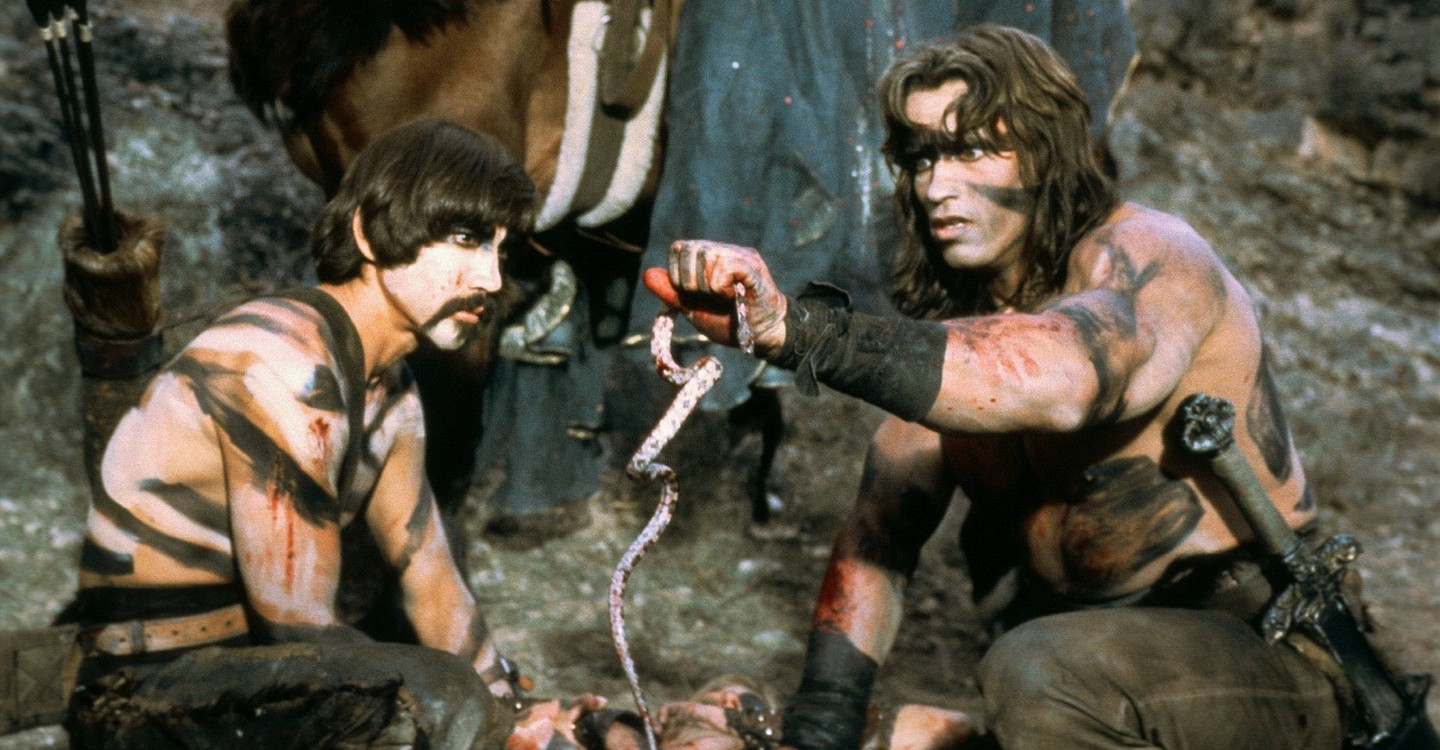
Lopez was sent to acting classes taught by co-star Mako, where he felt like a “total kook.” On set, though, his natural temperament became an asset nobody had planned for. His laid-back surfer’s calm gave Subotai an easy, grounded warmth that balanced the film’s operatic intensity. He described Bergman as feeling “like a sister” and brought a familial camaraderie to a grueling shoot in the Spanish desert. The fellowship between Subotai and Conan on screen didn’t need to be acted because it wasn’t.
The pattern extended well beyond the leads. Milius populated the Hyborian Age with bodies recruited from gyms and stadiums rather than casting calls. Sven-Ole Thorsen, a Danish bodybuilder and karate master, played Thorgrim, Thulsa Doom’s chief lieutenant and spent much of the village raid sequence falling off his horse. Ben Davidson, a 6’8″ former Oakland Raider, played Doom’s second lieutenant Rexor, leveraging his fluency in Spanish to bond with local horsemen. Franco Columbu, a two-time Mr. Olympia and Schwarzenegger’s closest training partner, appeared as the Pictish Scout. Even Kiyoshi Yamazaki, the film’s actual swordmaster, stepped in front of the camera to play the war master who trains Conan in the gladiator pits. That kind of casting doesn’t happen when you’re working from a talent agency’s roster.
How did James Earl Jones change the dynamics of Conan the Barbarian’s cast?
A film populated entirely by athletes risked feeling like a spectacle without a center of gravity. Milius solved this by casting the one role that required the opposite of everything he’d asked from everyone else. James Earl Jones, as the sorcerer-warlord Thulsa Doom, was the only classically trained actor.
By 1982, Jones’s credentials were staggering. A Tony Award winner. An Academy Award nominee for The Great White Hope. The voice of Darth Vader. A Shakespearean stage actor who had performed Othello, King Lear, and Coriolanus throughout the 1960s and 1970s, with a film career stretching back to Kubrick’s Dr. Strangelove. Placing him opposite Arnold Schwarzenegger was a deliberate collision of two entirely different performance traditions, and the film is built on the tension between them.
Jones treated the material with the same seriousness he’d bring to Shakespeare. He understood the film as “epic drama,” not B-movie camp, and refused to descend into what he called “cartoony ham.” That commitment elevated every scene he appeared in, but it also lifted the actors around him. A genuine symbiosis developed on set: Jones coached Schwarzenegger on acting technique and line delivery, while Schwarzenegger served as Jones’s personal trainer, putting the 50-year-old through rigorous physical workouts so he’d cut an imposing figure on camera. Jones got a body; Schwarzenegger got a performance.
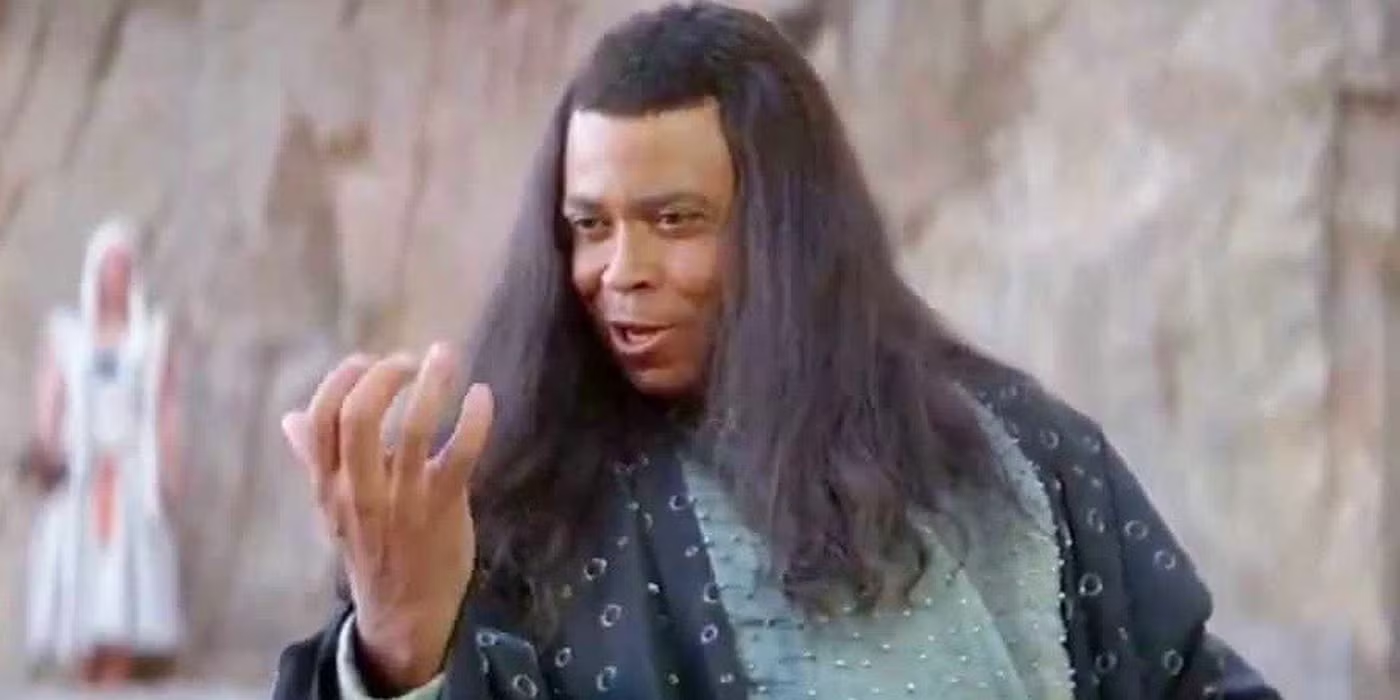
Milius directed Jones with a light hand that would have been unrecognizable to the rest of the cast. Where the athletes endured weeks of physical drilling and micromanaged choreography, Jones recalled a simpler process: Milius “had written a lot of speeches derived from the sayings of evil men throughout history, so he put a Teutonic wig on my head, placed me at the top of a canyon in southern Spain overlooking the Mediterranean, and told me to cut loose.” That was the direction. For a Juilliard-trained actor, it was enough.
The result is a villain who operates on an entirely different frequency than the world around him. In Doom’s first onscreen appearance, Jones has no dialogue at all. He relies on stillness, on a gaze that radiates seductive authority, and then he decapitates Conan’s mother with an abruptness that makes the silence before it feel like a trap. Later, in the Riddle of Steel sequence, he demonstrates his power by taunting the crucified Conan with a philosophy about flesh being stronger than metal.
That asymmetry is the film’s dramatic engine. Conan is a body in motion, solving problems with steel. Thulsa Doom is a mind that conquers through seduction and psychological domination. The casting created this contrast, creating a film where two characters who seem to exist in different genres entirely, collide in a world large enough to hold both.
Why did the unconventional casting of Conan the Barbarian work?
Casting athletes was only half the gamble. The other half was rebuilding every filmmaking decision around them so that their inexperience became invisible and their physical authority became the film’s primary language.
Cinematographer Duke Callaghan shot in expansive 2.35:1 widescreen, framing Schwarzenegger and Bergman against the vast Spanish landscapes and Ron Cobb’s monumental production design. At that scale, you don’t need close-up dramatic nuance when the performers are figures on a horizon.
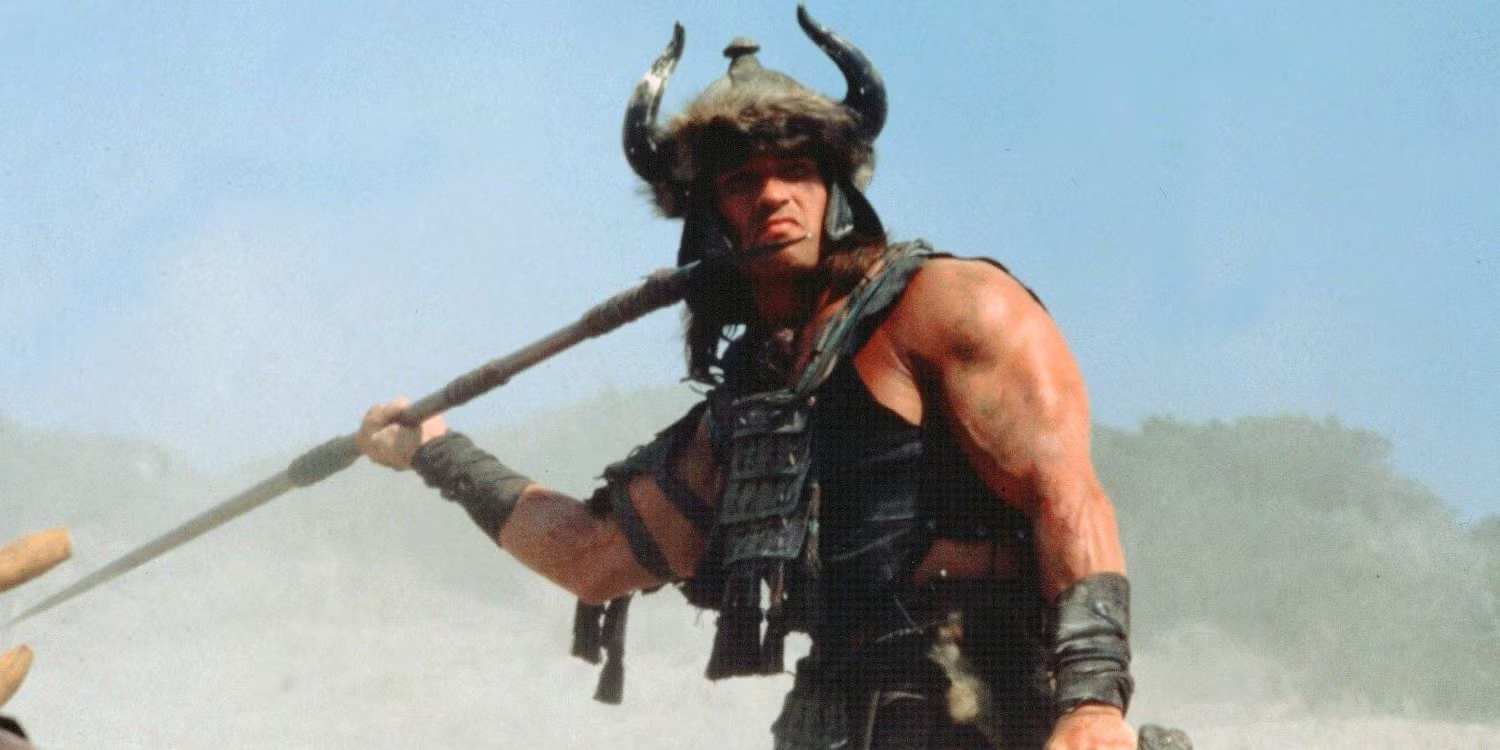
Milius reinforced this by rejecting optical special effects entirely in favor of mechanical, tangible reality. The sets were built at full scale. The Temple of Set was physically burned to the ground for the climactic sequence. The custom-forged swords weighed several pounds. Every physical interaction the actors had with their environment was genuine, which meant every reaction was genuine too. A trained actor can fake strain against a green screen. An athlete swinging real steel in real heat doesn’t have to fake anything.
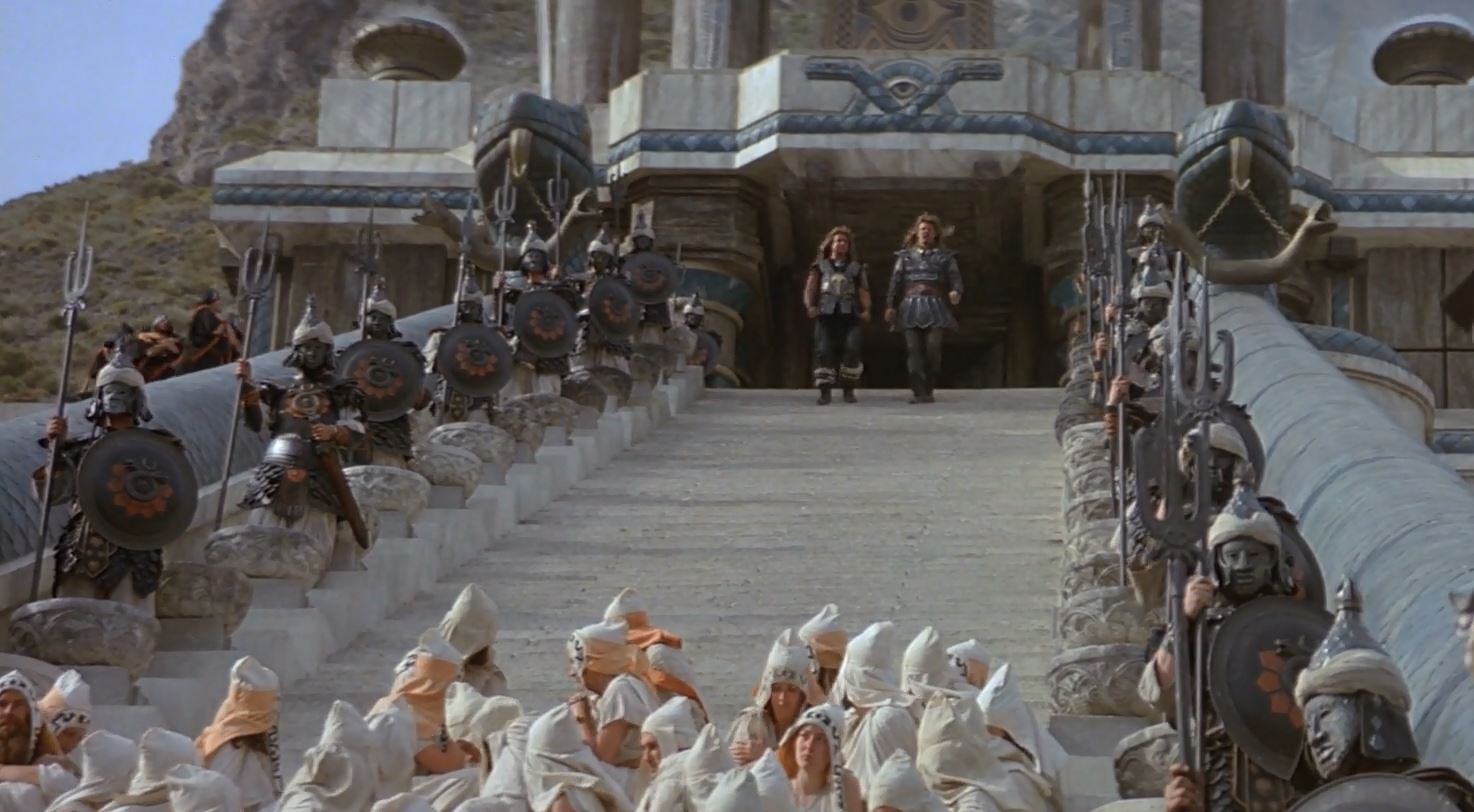
The combat reflects this principle at its sharpest. Because actual athletes were wielding actual weapons, the fight choreography registered as heavy, exhausting, and lethal. Audiences could see muscular strain, shifting body weight, and accumulating fatigue. The swashbuckling weightlessness of earlier Hollywood fantasy and the acrobatic flash that would dominate action cinema later in the decade are both absent here. What Yamazaki’s training produced instead was something closer to the way fighting actually works: ugly, desperate, and governed by who can stay on their feet longest.
Critics in 1982 didn’t universally know what to make of it. Many dismissed the non-actor casting as a gimmick and attacked the film’s violence and what they read as fascist aesthetics. Roger Ebert landed closer to the truth. His review was mixed but notably praised what the unconventional casting delivered: the “good health and good spirits” of Schwarzenegger and Bergman, a physical vitality that brought infectious energy to scenes that might have felt routine under traditional performers. He observed that Schwarzenegger silently conveyed the “joy of performing”, a quality that has nothing to do with dramatic training and everything to do with a man who is genuinely, visibly happy to be swinging a sword.
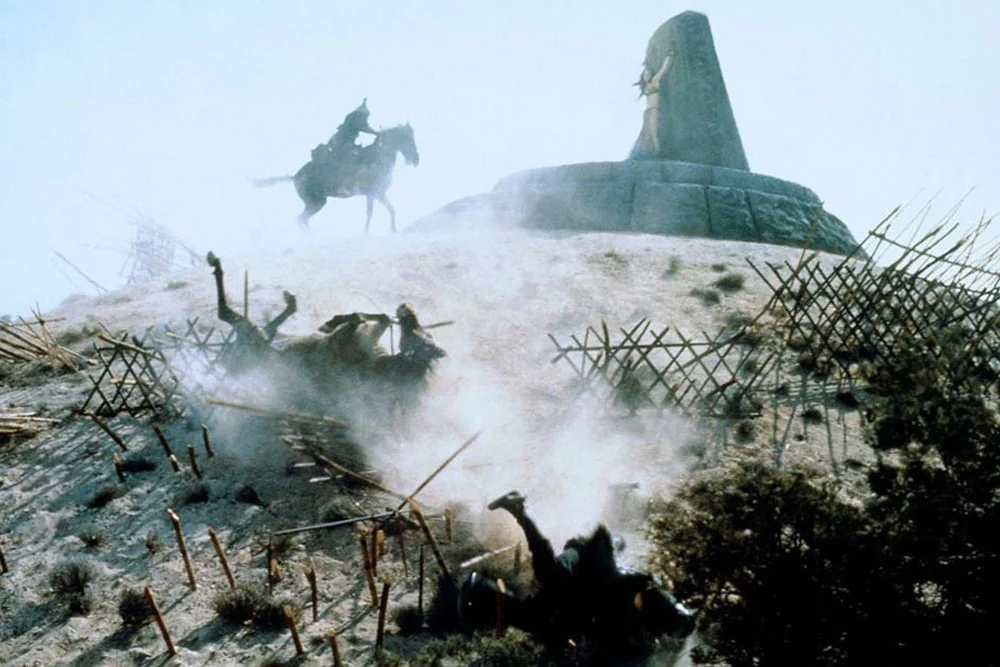
The scenes that have endured longest in the film’s reputation are the ones where that rawness is most exposed. When Schwarzenegger delivers the Crom prayer, his halting, heavily accented delivery strips away every layer of Hollywood polish. It sounds like exactly what it’s supposed to sound like: a warrior struggling to articulate theology he barely understands, bargaining with a god he’s never spoken to. A classically trained actor would have delivered those lines beautifully and broken the illusion entirely. The Battle of the Mounds works the same way: as Conan and Subotai fortify a position against Doom’s cavalry with traps and desperation, their genuine physical exhaustion sell the stakes more convincingly than any scripted tension could. These are scenes where rawness is not thought of as a limitation to be managed, but as the thing that makes the film feel true.
Why has no other sword-and-sorcery film matched the 1982 Conan the Barbarian?
The film grossed nearly $80 million worldwide on a $20 million budget, and Hollywood did what Hollywood does: it tried to replicate the formula. Throughout the 1980s, sword-and-sorcery flooded theaters. Every attempt missed.
The Beastmaster, released the same year, cast a traditional actor in Marc Singer and barely recouped its budget theatrically. Conan the Destroyer, the official 1984 sequel, kept Schwarzenegger but replaced everything else. Milius’s R-rated Wagnerian gravitas was swapped for a PG-13 family-friendly tone under director Richard Fleischer. Fans treated it as a betrayal. Red Sonja in 1985 brought back both Bergman and Schwarzenegger in diminished roles, but a lighter tone and weaker creative framework produced a film that felt like a photocopy of a photocopy.
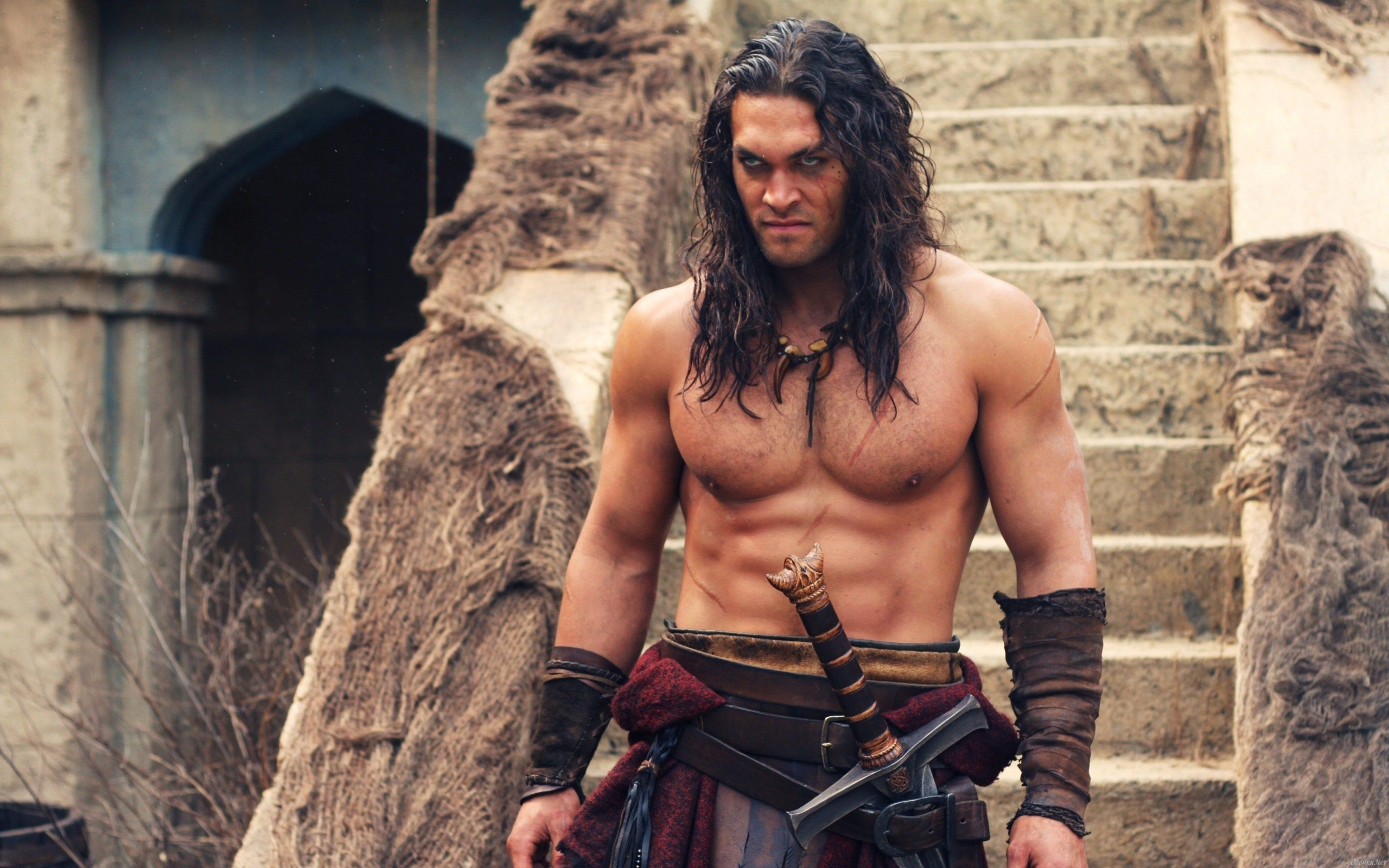
The clearest test came decades later: the 2011 Conan the Barbarian reboot cast Jason Momoa, a capable physical actor, and surrounded him with weightless CGI, rapid-fire editing, and a generic hard-rock aesthetic. Same character, different philosophy, critically catastrophic results. The reboot proved that the original’s power lived in the specific collision of elements that produced it, not in the film’s specific IP.
Those elements were unlikely ever going to converge again. Oliver Stone’s mythic screenplay structure. Ron Cobb’s historically grounded production design. Basil Poledouris’s orchestral score. Frank Frazetta’s visual legacy dictating casting decisions. And at the center, Milius’s absolute refusal to soften any of it. Remove one element and the formula weakens. Remove two and it collapses.
What Conan proved to the wider industry was narrower but permanent: audiences would follow a non-actor if the physical presence was extraordinary enough. That validation launched Schwarzenegger into The Terminator, Predator, and True Lies, and it opened the door for Jean-Claude Van Damme, Dolph Lundgren, and eventually Dwayne Johnson to build careers on the same principle.
The quality that separates the 1982 film from everything that followed it, though, isn’t the scale of its influence. It’s something smaller and harder to manufacture: earnestness. Milius’s Conan takes itself completely seriously. There is no wink, no self-deprecating humor, no moment where the film apologizes for being what it is. Modern fantasy and action films almost reflexively hedge their bets with irony. Conan offers none of that, and the reason traces directly back to the cast.
Schwarzenegger, Bergman, and Lopez didn’t possess the theatrical tools to distance themselves from the material. They couldn’t play at being warriors because playing requires a layer of artifice they hadn’t been trained to produce. What they could do was endure and let the camera record what endurance looks like. Anchored by James Earl Jones, that endurance became something more than competent physical performance: conviction. And conviction, in a genre built on asking audiences to believe in impossible worlds, turned out to be the thing no amount of money or technique could replicate.
Experience the 1982 Conan the Barbarian for yourself
Reading about what makes the 1982 Conan the Barbarian singular only goes so far.
The weight of Yamazaki’s sword choreography, the collision between Schwarzenegger’s silence and Jones’s baritone, or the moment Bergman’s dance training turns a fight scene into something genuinely dangerous, are things you need to witness, not summarize.
Watch or rewatch the film, and pay attention to what the cast’s bodies are doing when their mouths aren’t moving. That’s where the film lives.
And when you’re ready to go deeper into the world Robert E. Howard built explore the stories, the comics, and the expanding Conan universe at conan.com.

Lo Terry
In his effort to help Heroic Signatures tell legendary stories, Lo Terry does a lot. Sometimes, that means spearheading an innovative, AI-driven tavern adventure. In others it means writing words in the voice of a mischievous merchant for people to chuckle at. It's a fun time.