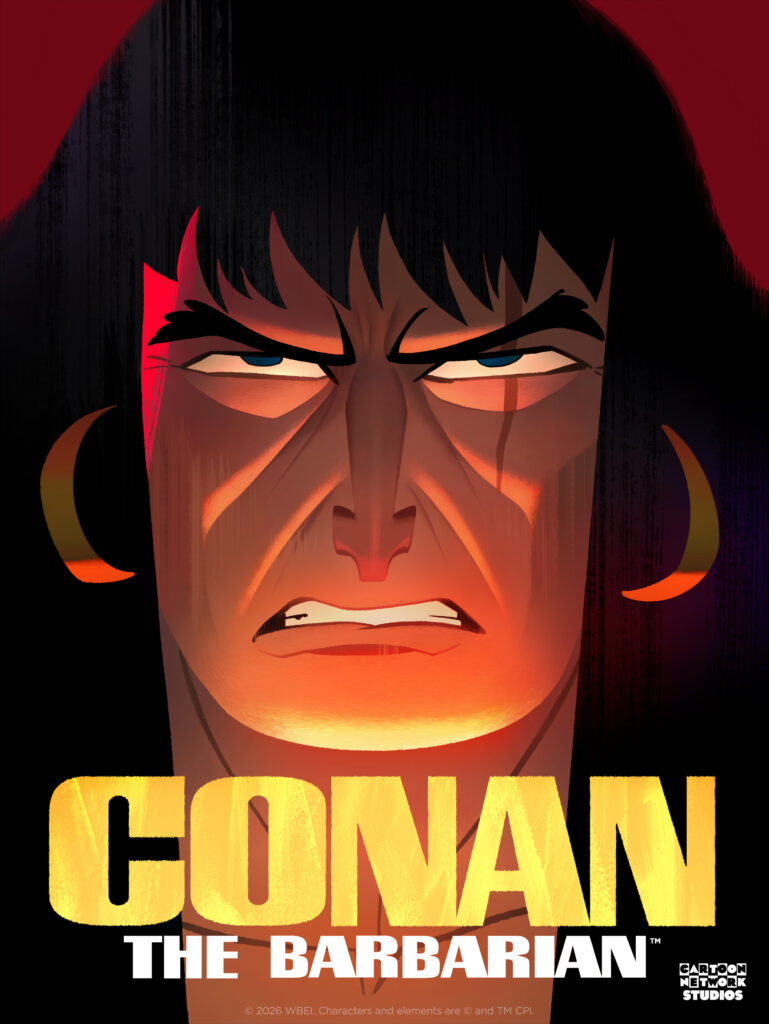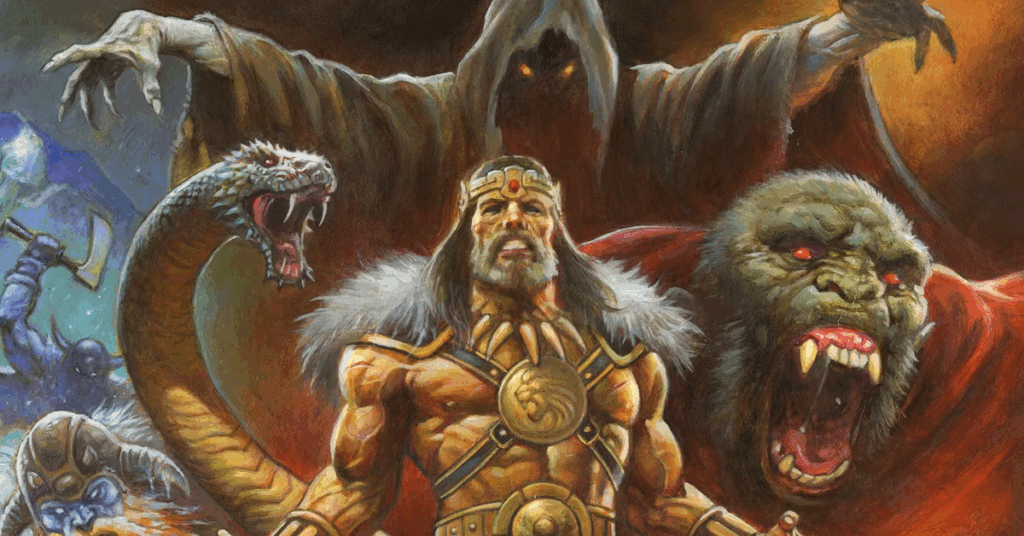



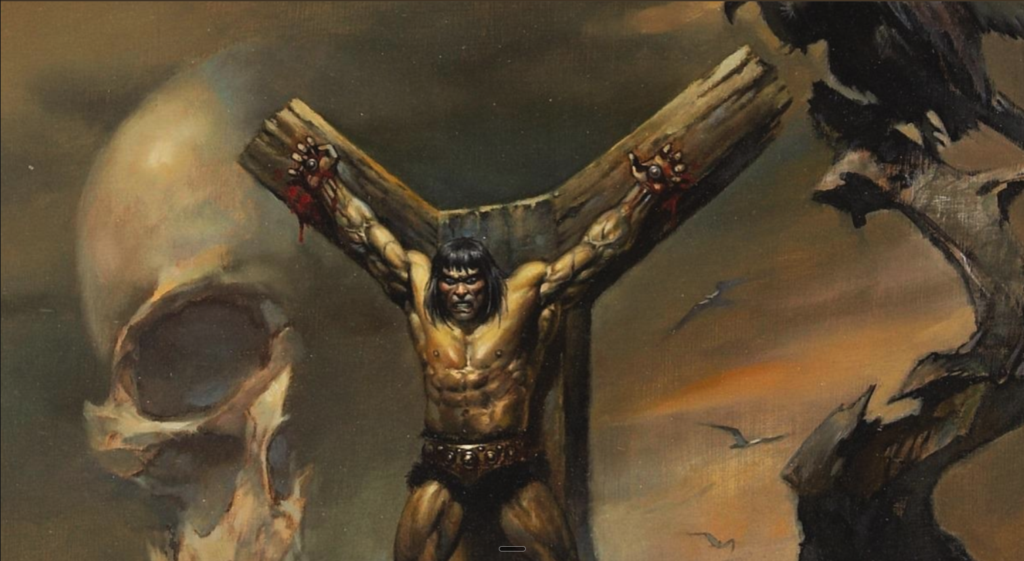
In December 1932, Weird Tales printed “The Phoenix on the Sword.” It was Robert E. Howard’s first Conan story, and the Cimmerian who walked out of it became the founding hero of sword and sorcery.
He has been walking into ruined temples and sorcerers’ towers ever since. Some of what he found inside has followed readers home and stayed with them for years—and not for good reasons.
Halloween felt like the right night to go looking for those things that haunt from the shadows. So, we went back through everything we inherited, from Marvel’s first Conan comic in 1970 to Titan’s books today, hunting for the scenes fans still bring up long after their first read.
The Hyborian Age Always Had Room for the Dark
Howard grounded Conan’s world in hard, earthly things. Kingdoms fall to steel and hunger. A man who swings a sword feels the weight of it in his shoulders the next morning. So when sorcery shows up, it hits like a blow from behind. Nobody in that world can explain away what crawls out of an old tomb, and a sword may not be enough to answer it.
That realism is why sword and sorcery always made room for horror. Howard wrote for Weird Tales, a pulp that ran fantasy and horror side by side, and he traded letters with H.P. Lovecraft.
The comics carried that forward, and each format decided how much a reader got to see. Marvel’s color Conan the Barbarian ran 275 issues from 1970 to 1993 under the Comics Code, so its frights came through shadow and inhuman monsters. The Savage Sword of Conan ran 235 issues from 1974 to 1995 as a black-and-white magazine outside the Code, sharing newsstand racks with Warren’s Creepy and Eerie. It could show violence and cruelty the color book couldn’t, and fans still call it the darker of the two.
Many Howard stories were drawn more than once. Roy Thomas adapted them at Marvel in the 1970s, and Dark Horse returned to many of the same tales decades later.
Titan also reprints the classics, including Savage Sword of Conan: Reforged, which colorizes the old black-and-white pages.
Regardless of what well of Conan’s you’re drawing from, one thing is for certain: you won’t have to wait long before you run across something that steals your breath.
Already in the Room
Some of the worst things in Howard’s world get there before Conan does. They sit still and wait while he walks in, and by the time anyone sees them, they are close enough to touch.
The Thing Behind the Screen
Howard called this one “The God in the Bowl,” and Roy Thomas and Barry Windsor-Smith brought it to Marvel’s Conan the Barbarian #7 in 1971. Conan comes to the city of Numalia as a thief. The prize is a Stygian sarcophagus bowl kept in the museum-house of the merchant Kallian Publico, and the barbarian slips inside at night to take it.
He finds the bowl already open and Kallian lying dead on the floor. Then the city watch arrives, and a big foreigner standing over a dead rich man makes an easy suspect. They corner Conan and question him about the murder while the shadows of the house stretch long around them.
The questions go on and on. All that time, behind a gilded screen, the thing that came out of the bowl has been waiting: a giant serpent’s coiling body under a head that looks almost human. When it finally moves, it goes for the men in the darkened building, and Conan has to answer it with his sword.
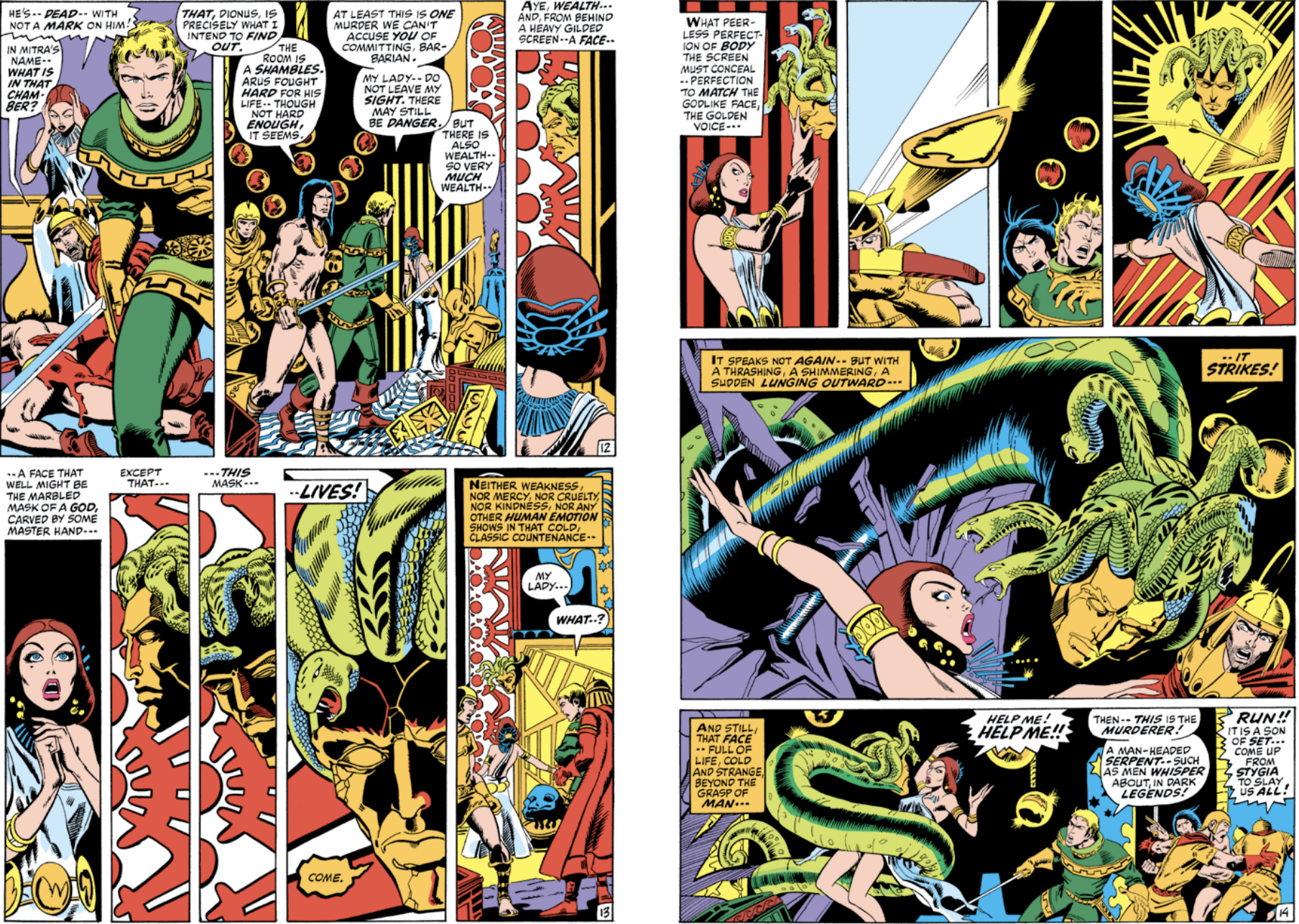
Readers who come back to this one remember the sorcery and the slow climb of fear while the killer sits in the same room. When Kurt Busiek and Cary Nord retold it for Dark Horse in 2004, in Conan #10–11, their version found admirers of its own, who talk about how menacing its threats feel. Other readers are unsettled by the way the story folds a murder mystery into cosmic menace. Titan’s Conan the Barbarian: The Original Comics Omnibus Vol. 1 (2024) reprints the 1971 issue for anyone who wants to start where Marvel did.
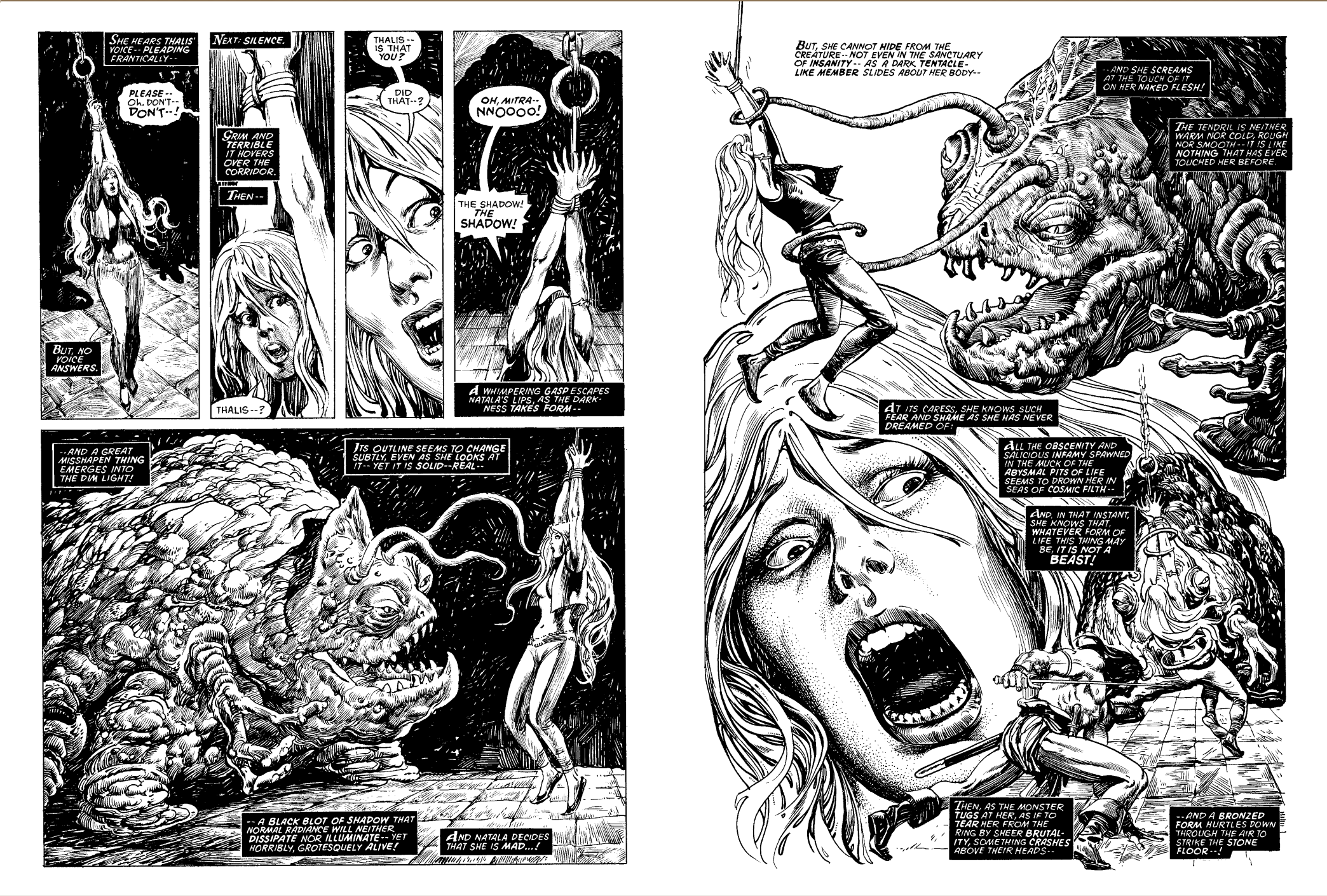
The Shadow in Xuthal
The desert has nearly finished Conan and Natala when they find the city of Xuthal. There are walls there, and shade, so they go in.
The palace is dark and nearly empty, its halls running on with hardly anyone in them. The quiet has weight. Somewhere in it, something is moving along the walls, and all you get of it is a sliding shadow.
Its name is Thog, and it is ancient. Thalis, a Stygian woman who wants Conan for herself, drags Natala off to feed her to it. The toad-like thing takes Thalis instead, then comes back for Natala. When Conan goes after it, Thog seizes him, and the two of them go tumbling down an underground tunnel together in the black. It batters him. He hacks at it with saber and poniard until it comes apart, and then he and Natala flee Xuthal for the open desert.
The part readers describe most is the stretch before Thog shows itself, when something is moving through a deserted palace and nobody can see it. Roy Thomas adapted Howard’s “The Slithering Shadow” for The Savage Sword of Conan #20 in 1977, with John Buscema and Alfredo Alcala on the art, and the monster sits right there on the cover. Fans credit Buscema’s design with giving Thog the feel of a Lovecraftian monster-god. It turns up whenever fans list Conan’s most terrifying monsters, and some of them say this Savage Sword adaptation is the reason it stayed with them.
Eight Legs from the Ceiling
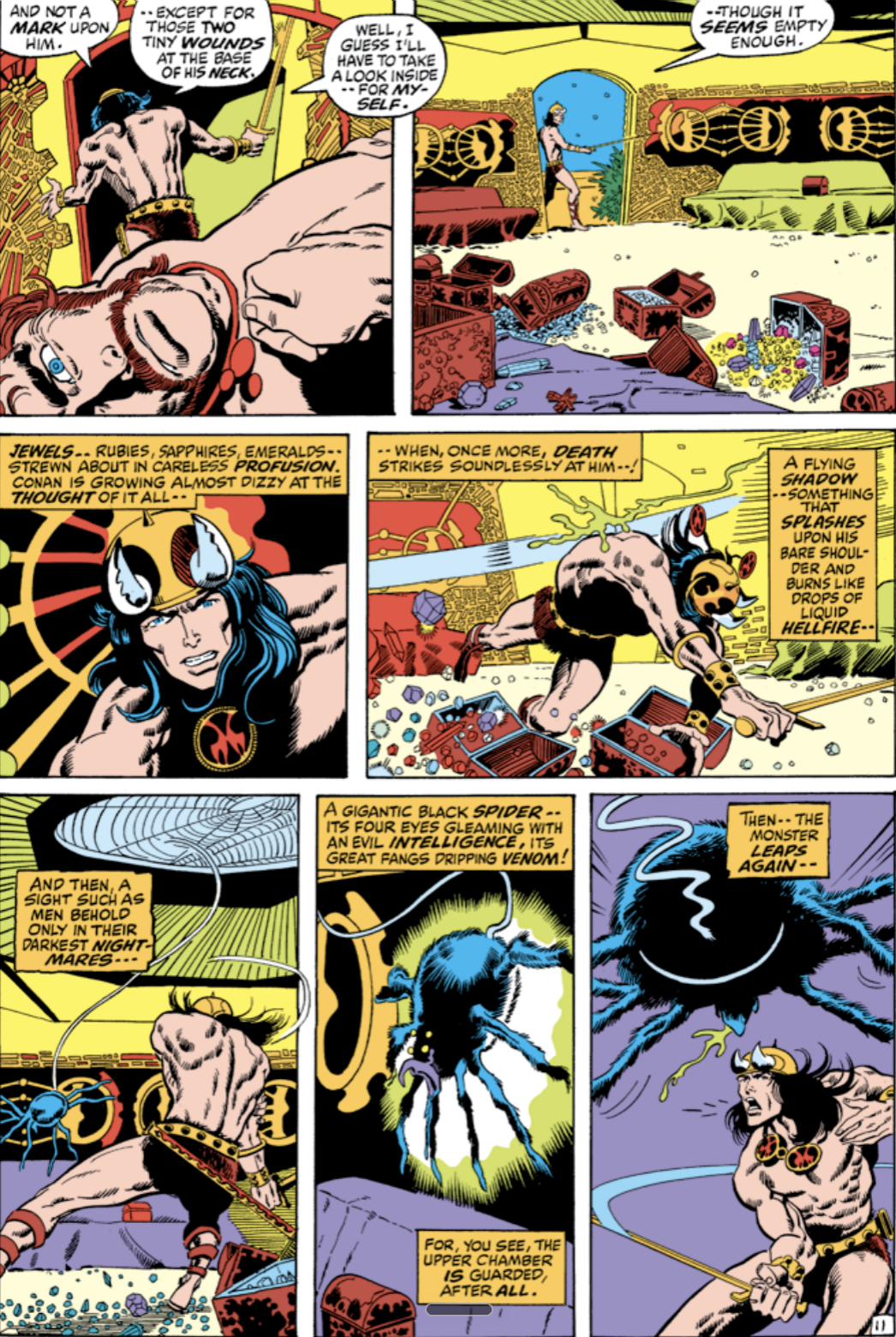
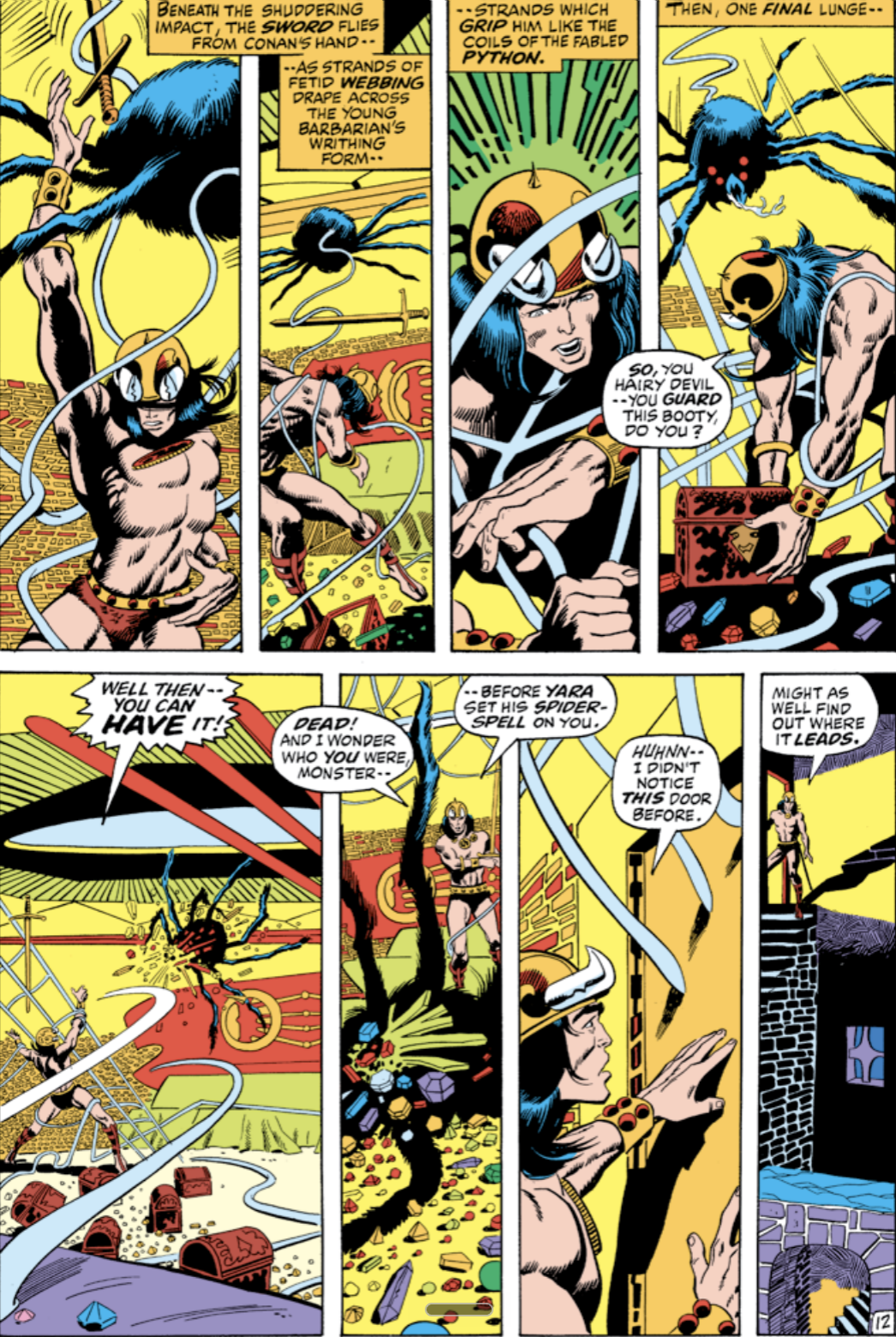
In Zamora, a young Conan decides to rob the jeweled tower of the sorcerer Yara. He goes up the outside of it hand over hand, with the city falling away beneath him.
Near the top he finds a treasure chamber and gets in, alone with the jewels as far as he can tell.
A black spider the size of a pig swings down at him from the ceiling. Venom from its fangs splashes across his bare shoulder. Then it is on the floor and coming, scuttling after him across the chamber, fast and low, until Conan heaves up a heavy chest and crushes it.
Readers with arachnophobia single this one out, and Howard’s own prose in “The Tower of the Elephant” likens the creature to a spider out of nightmares. Artists haven’t been able to leave it alone. Barry Windsor-Smith drew it first for Roy Thomas in Conan the Barbarian #4 (1971), and John Buscema took his turn in The Savage Sword of Conan #24 six years later. Kurt Busiek and Cary Nord brought it back for Dark Horse’s Conan #20–22 in 2005.
The Dead Don’t Stay Down
Graves in Conan’s world have a bad habit of opening. Every era of the comics has pried one up, and whatever climbs out is in no hurry to lie back down.
The Keeper on the Throne
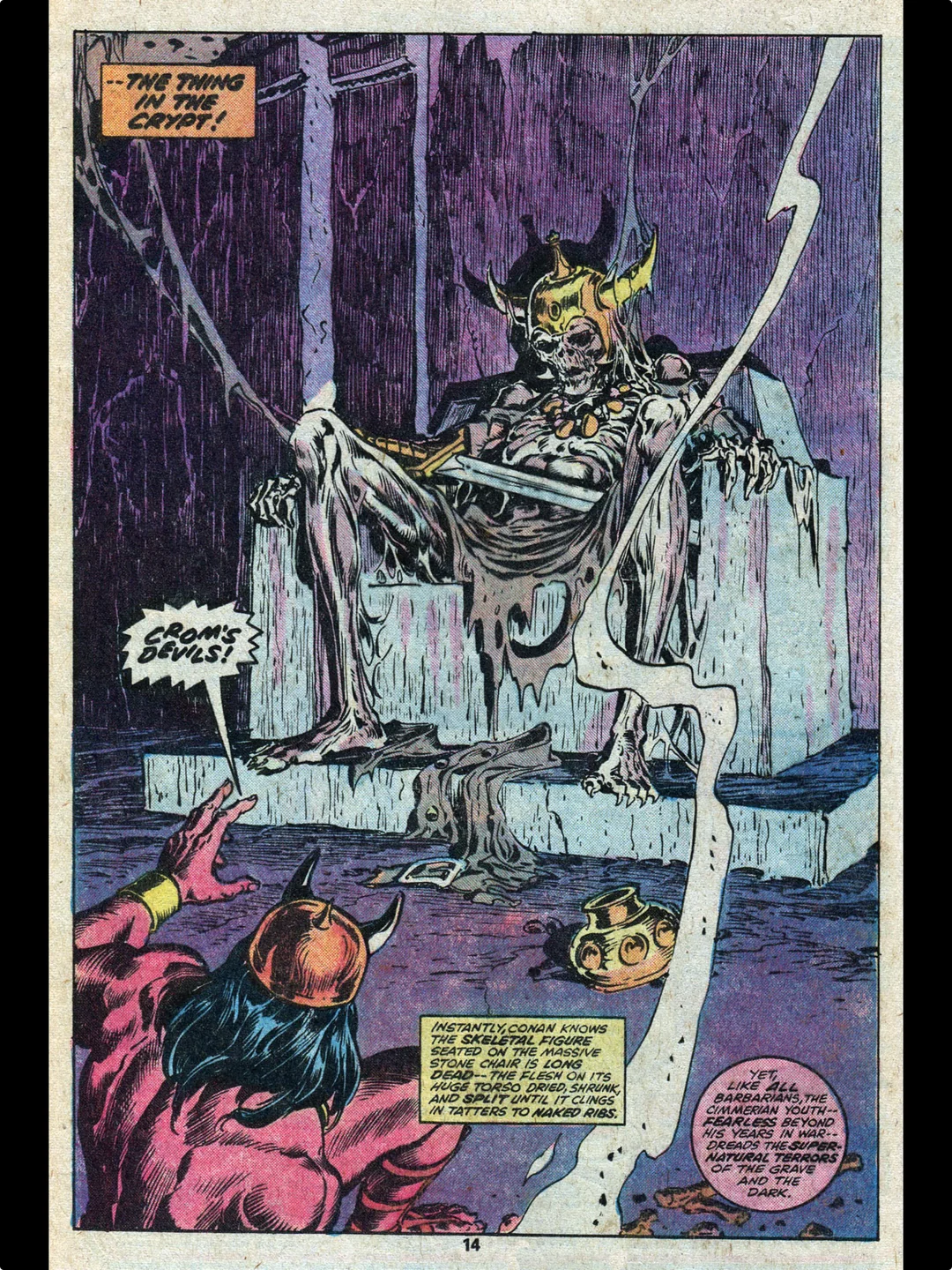
The wolves come first. Conan is still young, running across the snow with the pack closing behind him, and he does what any hunted animal would do: he finds a cave and gets inside.
The cave is a tomb. A giant sits upright on a throne in the blackness, mummified, with an ancient iron sword laid across its knees. A youth with wolves at the door sees a weapon and nothing else. He takes it.
The corpse wakes.
Now Conan is trapped underground with a dead giant whose sword he has just stolen, and the only way out is to destroy it. Fans talk about how frightening that mummy’s persistence is, how it never ceased its watch over the sword.
Purists will want to know that Howard didn’t write this one. L. Sprague de Camp and Lin Carter wrote “The Thing in the Crypt” in 1967, working in Howard’s tradition. Roy Thomas brought it to Marvel eleven years later in Conan the Barbarian #92, with Sal Buscema laying out the pages and Ernie Chan finishing them.
What the Tide Brought In
Conan tells this one himself. It reaches back to his early wanderings, to a village on the coast where he happened to be when the sea gave something back.
A drowned man washes up on the shore. For a little while he is only that, a body brought in by the tide, one more loss for a village that lives by the water. Then he gets up and starts killing the villagers.
Somebody has to stand in his way. Conan does, naturally.
Roy Thomas and Val Mayerik built Conan the Barbarian #69 (1976) out of Howard’s “Out of the Deep” and titled it “Demon Out of the Deep!” What they give you is a horror-movie plot straight out of the 70s. Because Conan is the one telling it, years later, you hear it the way you’d hear a story by a fire from someone who was actually on that beach. It’s a classic for a reason.
The Army of the Lost
Titan opened its run in 2023 with this one. In Conan the Barbarian #1, the first chapter of Jim Zub and Roberto De La Torre’s “Bound in Black Stone,” a young Conan travels near the Cimmerian border with Brissa, a Pictish scout. Out past that border, the wilderness belongs to her people.
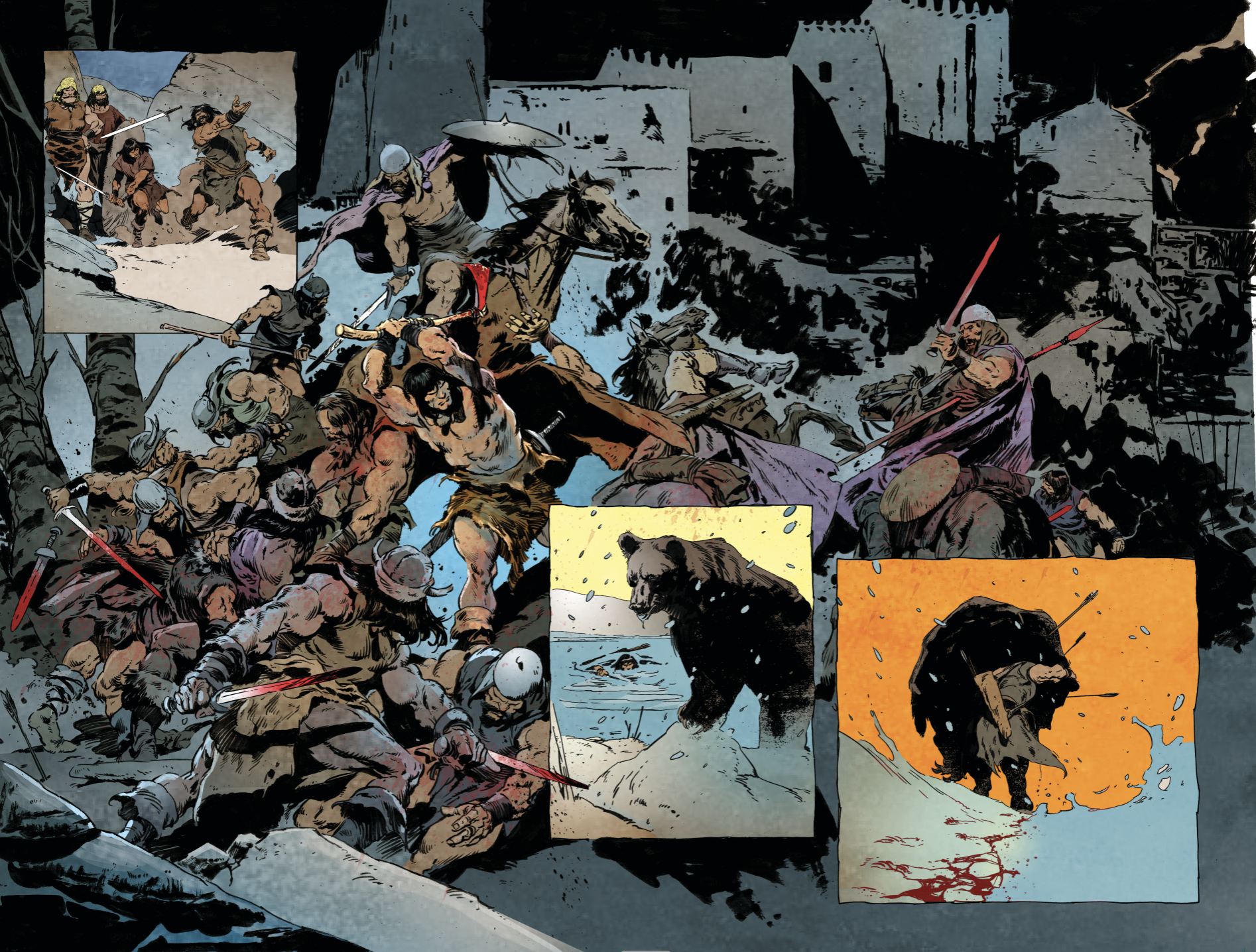
Sorcery tied to a black stone raises a horde of dead Picts, and they swarm out of the wilderness. Conan and Brissa end up back to back, swinging into a mass of bodies that should have stayed in the ground in a fight that roars on.
When it was released, fans spoke about macabre undead savages and a cold you can almost feel coming off the art. The story is collected in Conan the Barbarian Vol. 1: Bound in Black Stone (2024).
In the Sorcerer’s House
Sorcery raised the Picts, and sorcery is the one enemy Conan’s steel has the hardest time answering. In these two stories he goes down into the places where it lives.
The Pits Beneath the Scarlet Citadel
Conan wears a crown in this one, but it does him no good at all.
The sorcerer Tsotha-lanti takes him captive and chains him in the pits beneath the Scarlet Citadel of Khorshemish. Then, the giant serpent Satha comes out of the shadows and kills a slave sent down to murder him. Conan takes the keys from the body and starts walking.
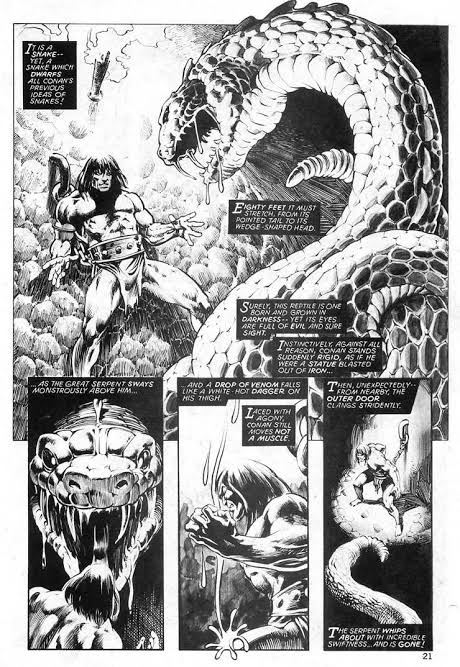
He passes a well with no bottom. Something waits beyond it: a weeping, jelly-like thing whose malformed tentacles give it the rough outline of an octopus. Conan backs away.
Further on he finds a man held inside a carnivorous plant. The plant has kept him alive for years so it can go on feeding on him. Conan cuts him free. The man is Pelias, and Pelias is a sorcerer. Satha is still down there with them, and Pelias stares the serpent down until it retreats. Then he turns to Shukeli, the jailer who slammed the grille in Conan’s face and took Conan’s sword through the bars for it. The dead man gets up and opens the grille from the other side.
Fans have argued for years over which part is worst. The shapeless thing past the well has its champions, and so does the plant, which some call the most horrible thing in the story. Others can’t shake the dead man walking to the door. A few find Pelias the most frightening of all because he’s on Conan’s side.
Most readers know this sequence from Howard’s prose. Roy Thomas and Frank Brunner gave it dozens of pages in The Savage Sword of Conan #30 in 1978.
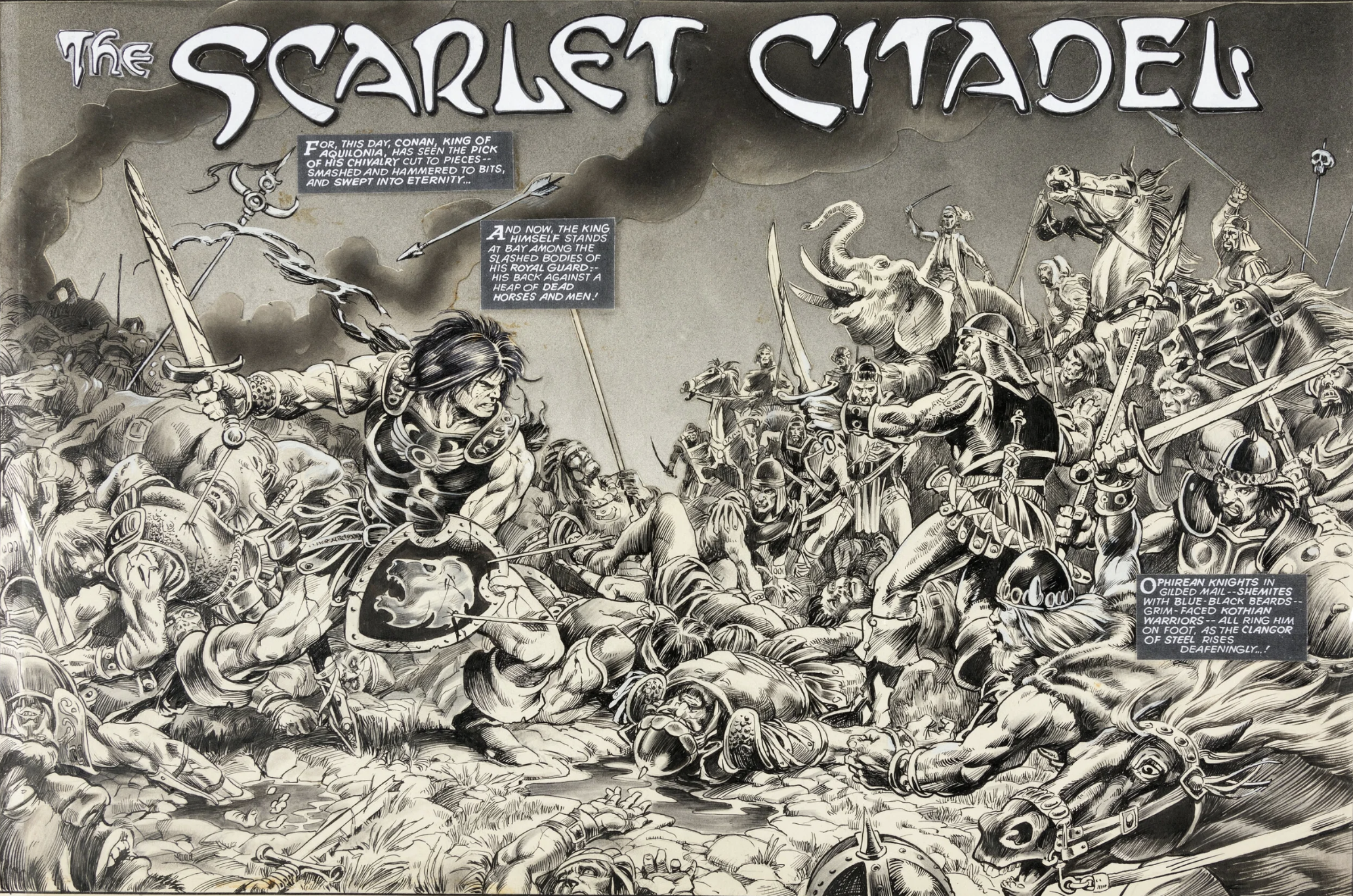
Timothy Truman and Tomás Giorello went back down into those pits for Dark Horse’s King Conan: The Scarlet Citadel in 2011.
Trust us: it reads differently once you see it drawn.
Akivasha Beneath the Pyramid
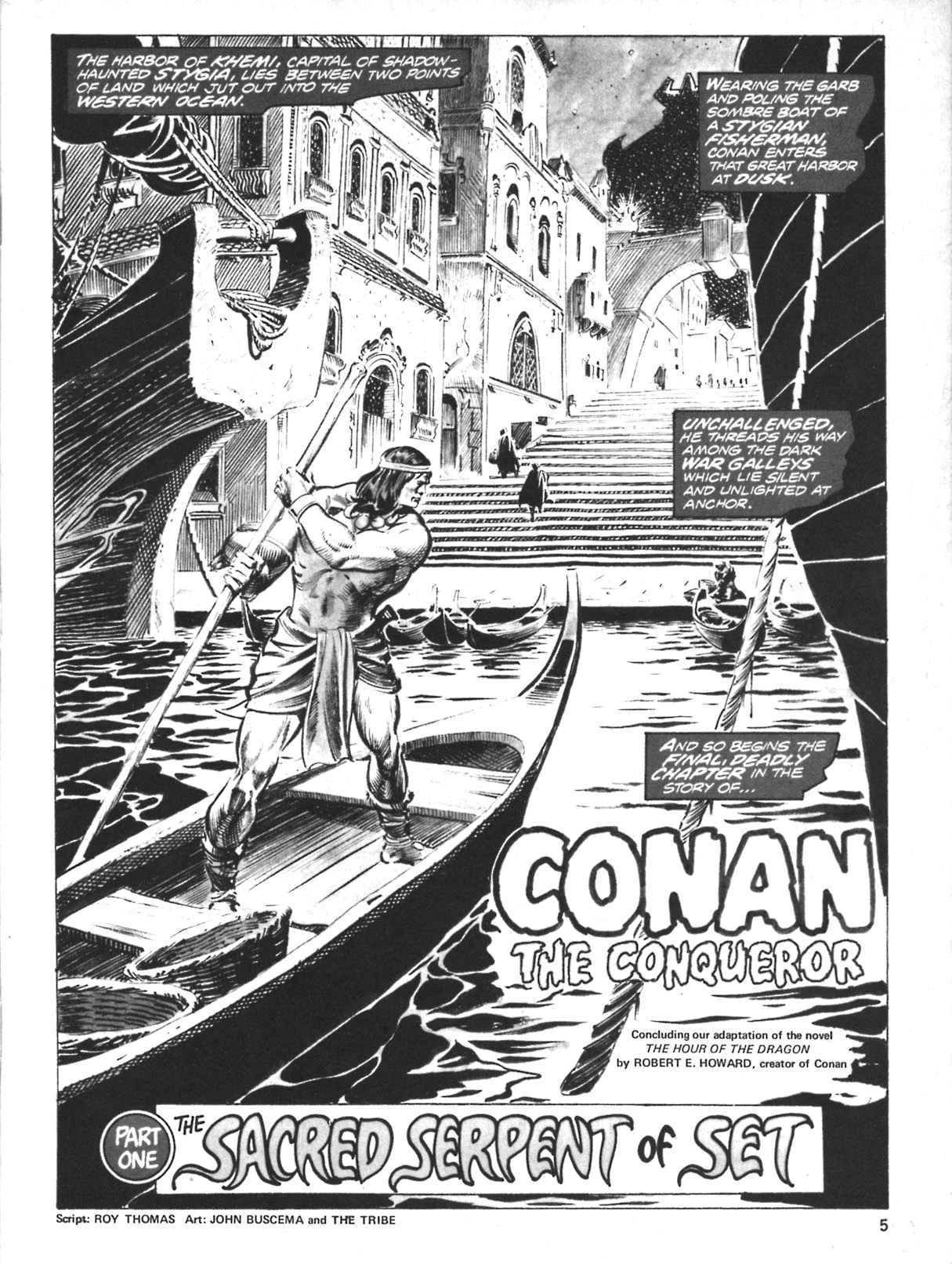
The Hour of the Dragon is Howard’s only Conan novel, and this scene sits deep inside it. Conan is a king again, this time with his throne stolen out from under him, and he is hunting a jewel called the Heart of Ahriman. The trail takes him into Khemi, a city of Stygia. He slips in quietly and goes down alone into the catacombs beneath a black pyramid.
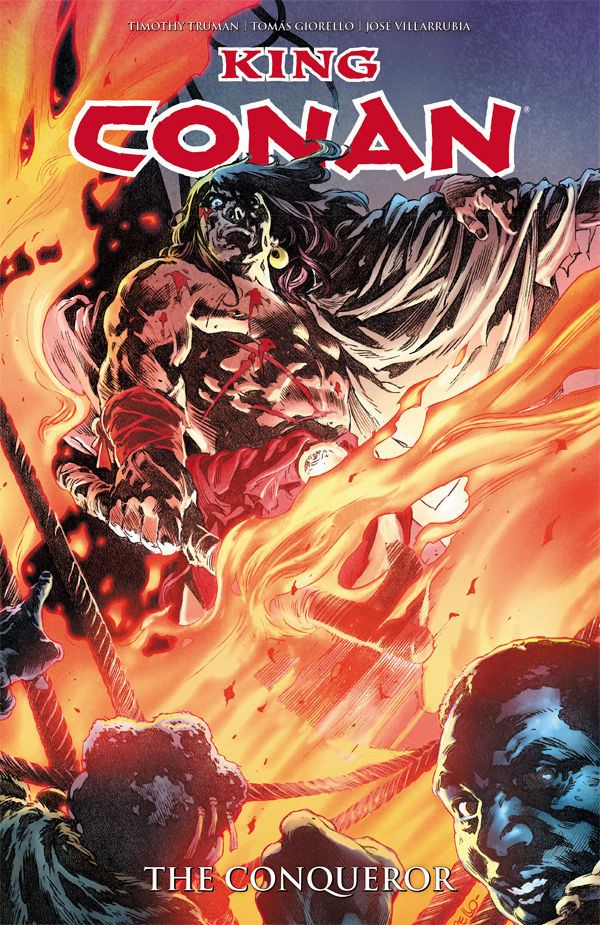
Someone finds him there. She is Akivasha, the immortal vampire princess, and she has an offer for him. She wants him to come with her into an undeath that never ends.
Conan’s answer is his sword. He threatens to cut her apart with it and finds his way out of that tomb.
Readers remember this as the eeriest stretch of the book, as it’s marked by a man alone under a pyramid with something that has outlived its own death—and wants him to stay. Roy Thomas adapted the encounter in The Savage Sword of Conan #10 in 1976.
Decades later, Timothy Truman and Tomás Giorello gave Akivasha a whole issue of her own at Dark Horse, King Conan: The Conqueror #4, “The Crypt of Akivasha.”
When the Monster Is a Man
Everything so far has crawled out of a pit or a tomb. Savage Sword worked outside the Comics Code, and that freedom reached further than its monsters in that it let the magazine show what people do to each other.
The Tired Executioner
“The Boon,” the backup story in The Savage Sword of Conan #116 from 1985, opens on a condemned man and the executioner sent to take his head.
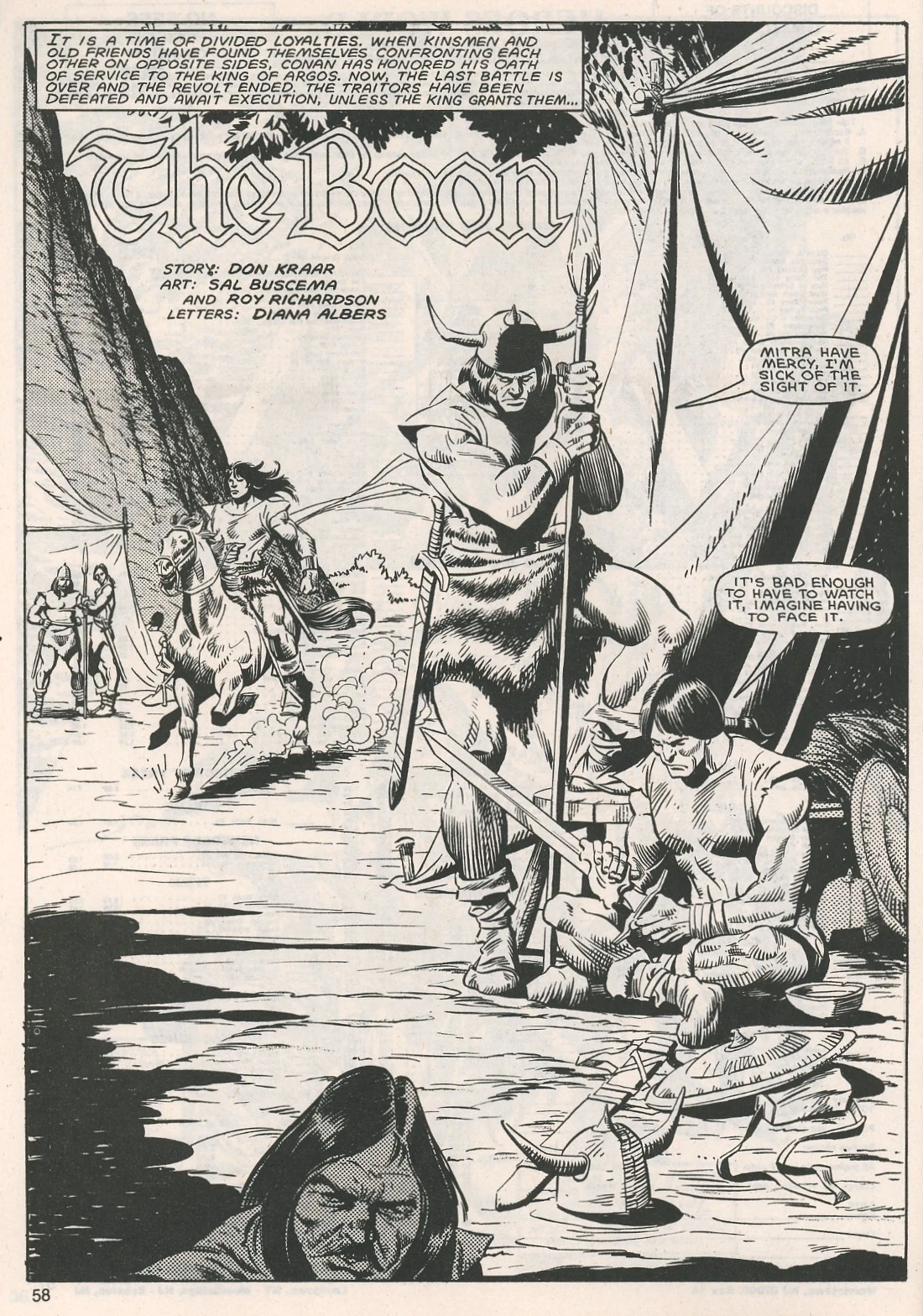
Afterward he complains that he is tired. He has been working for hours.
Readers remember that complaint. The dead man is already behind him, and the headsman just wants someone to know he’s had a long day.
Later in the story, Conan stands over a kneeling friend with an axe in his hands, and he says he wants no part of this. We’ll stop there.
In the King’s Way
Steven DeKnight wrote “Ship of the Damned” for King-Size Conan #1 in 2021, and in it Conan is a mercenary in the army of a colonial ruler of Yezdigerd. The enemy is the local population, and women and children are among them. In the battle, Conan kills a woman.
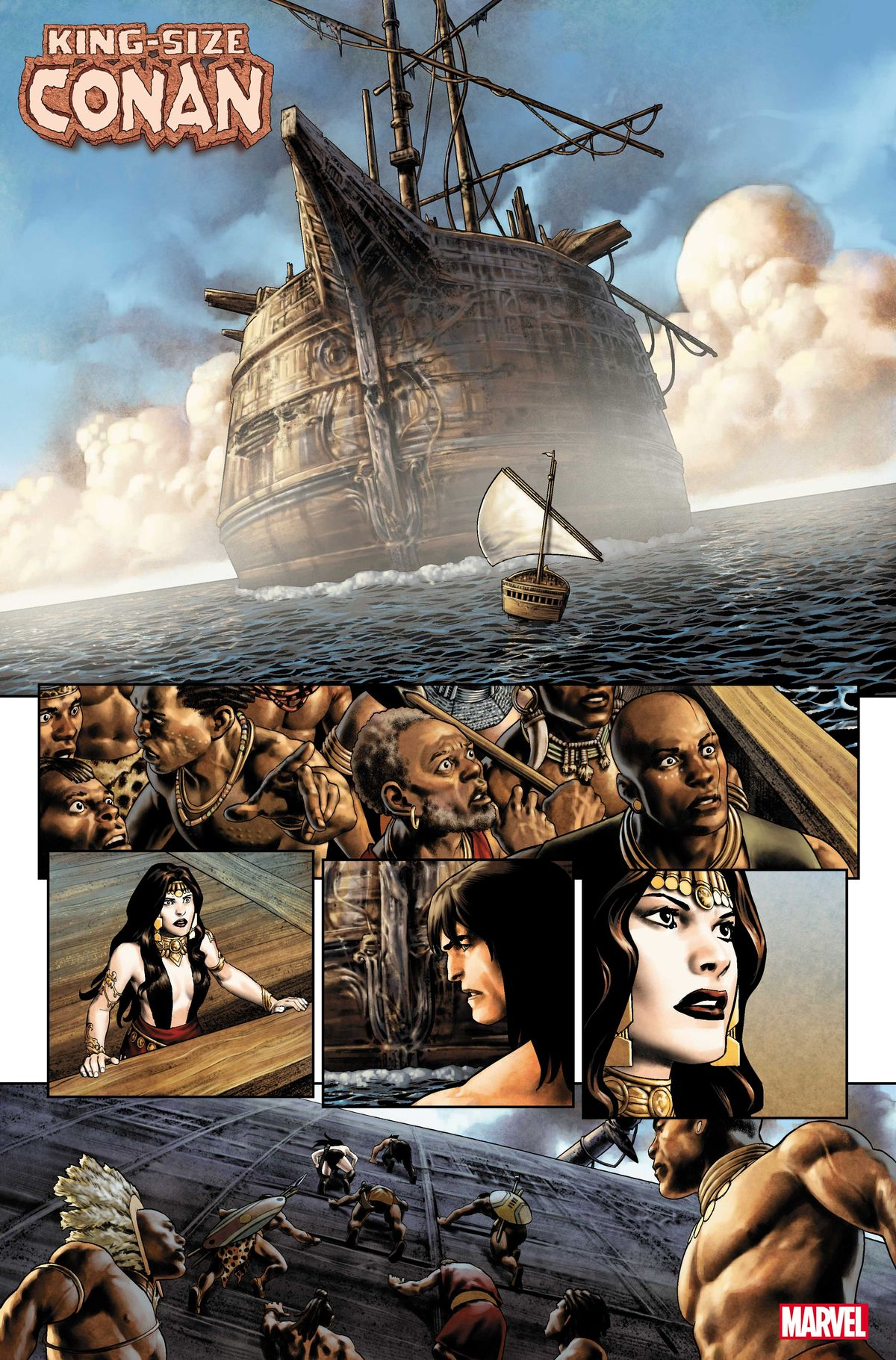
When the fighting ends he finds her daughter. The girl is wounded and holding her mother’s body, and she confronts him anyway. Conan gives her the only answer he has: they were in the King’s way, and the gods care nothing for them.
She tells him she will wait for him in the next world, and she will fight him again there. Then she dies.
Before the Torch Goes Out
We hope you’ve enjoyed this trip into the dark, and we want you to keep it going.
What are the scariest moments in Conan for you, whether they live in the comics or in Howard’s original stories?
Share them with us. We genuinely want to know which scenes stayed with you, and which one made you afraid to blow out the torch.

Lo Terry
In his effort to help Heroic Signatures tell legendary stories, Lo Terry does a lot. Sometimes, that means spearheading an innovative, AI-driven tavern adventure. In others it means writing words in the voice of a mischievous merchant for people to chuckle at. It's a fun time.