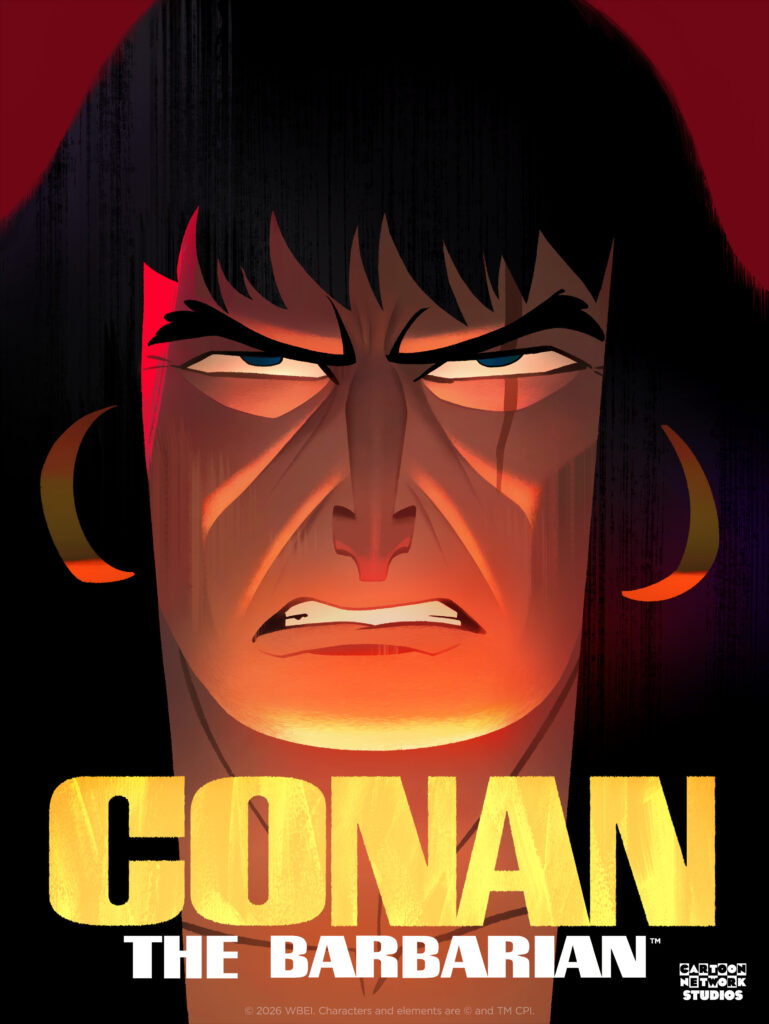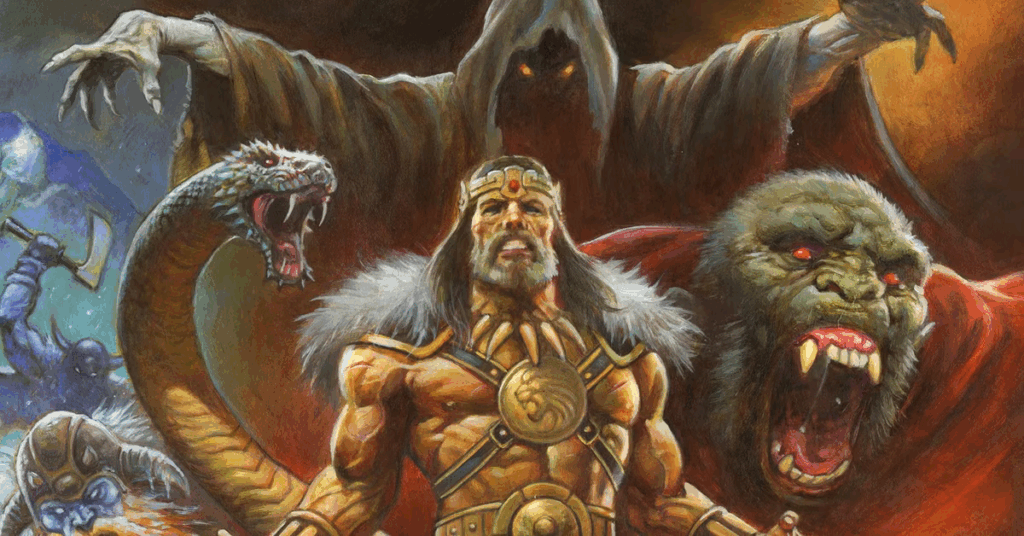




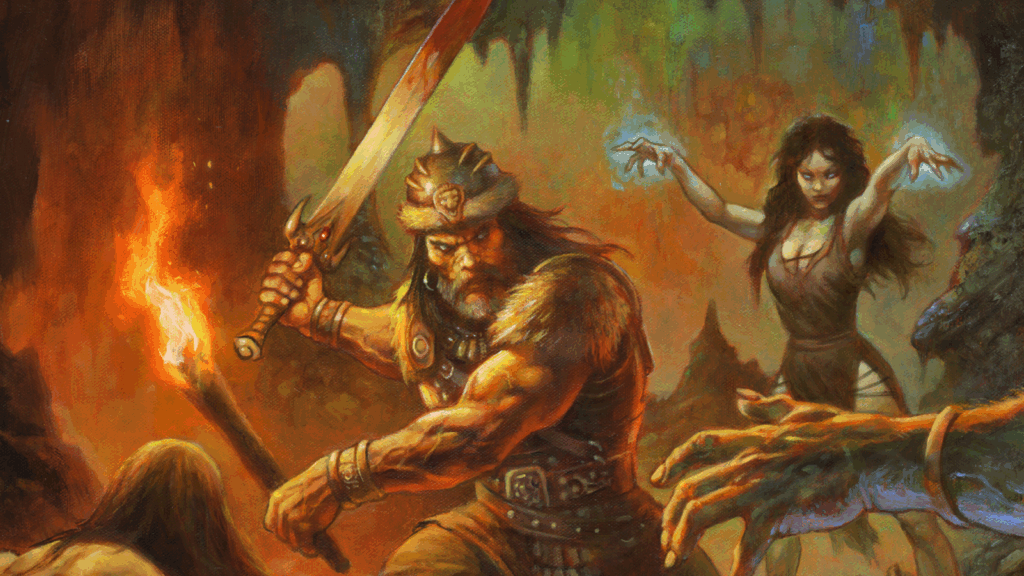
Conan the Barbarian is one of the most recognized characters in fantasy and one of the least understood.
Nearly everything the general public believes about him, like the grunting, the mindlessness, or the cartoonish machismo, was invented by someone other than his creator.
The real Conan, the one Robert E. Howard actually wrote, is a different man entirely.
And, if you’ve ever loved a wandering swordsman in anything you’ve read, watched, or played, you’ve already met him without knowing it.
The Costume
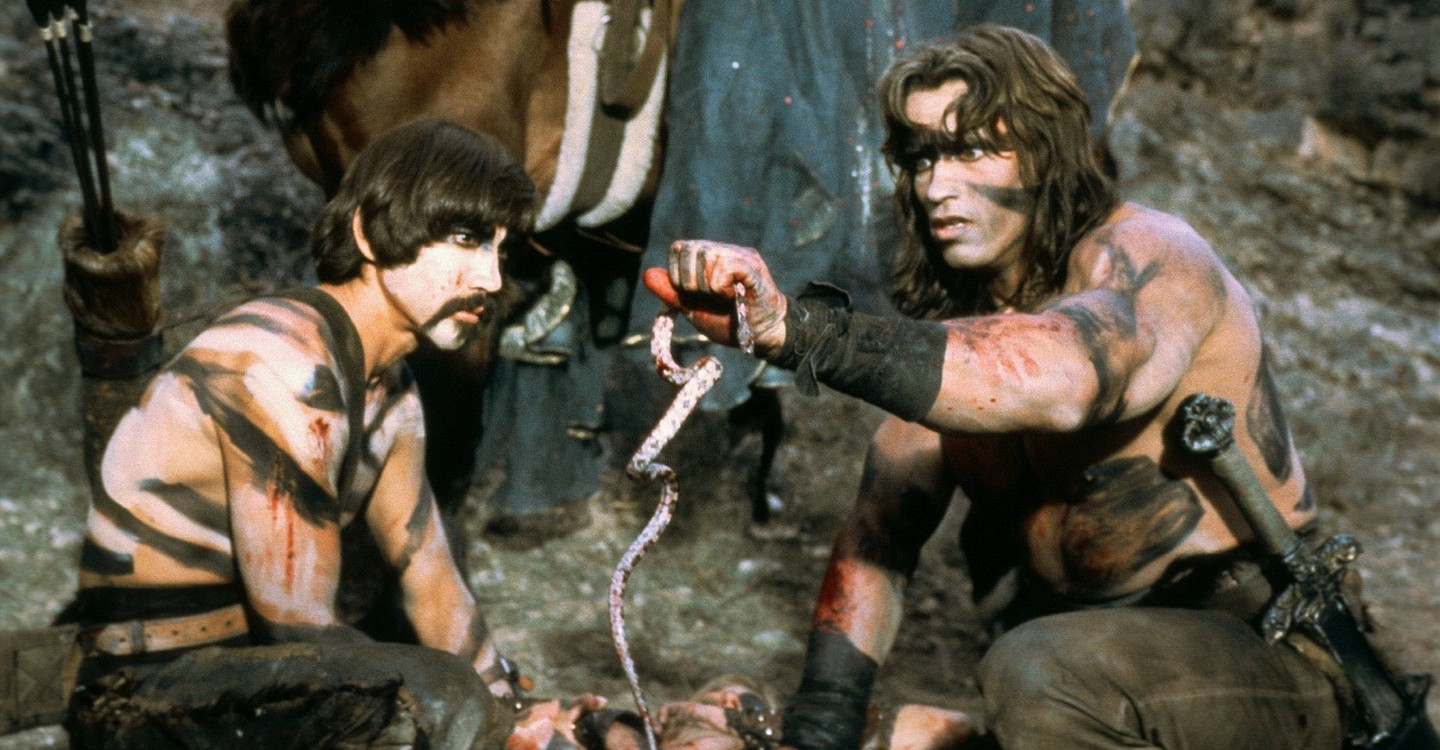
Picture Conan. You probably see Schwarzenegger’s Austrian accent, the Wheel of Pain, Thulsa Doom hissing under a black bob, the “what is best in life” speech.
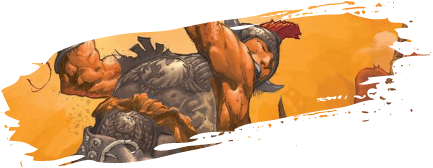
Or you see Frazetta’s Lancer paperback covers from the late sixties: Conan straddling a monstrous serpent on Conan the Usurper, standing over a dying foe in red snow on Conan the Adventurer, all loincloth and bicep and nineteenth-century survival-of-the-fittest iconography.
None of that came from Robert E. Howard.
The actual Conan was written on a typewriter in Cross Plains, Texas, in late 1932. The man at the keys was 26-year-old Robert E. Howard, sole caregiver to his mother Hester, who was dying of tuberculosis in the trough of the Great Depression.
He was rewriting an unsold King Kull manuscript called “By This Axe I Rule!” into something he would retitle “The Phoenix on the Sword.” He pounded the keys and spoke the dialogue aloud as he wrote.
Everything else you know about him got bolted on later and, worryingly, depicts in your mind’s eye a man that just wasn’t written that way.
The Receipts
The most common framing of Conan as a “monosyllabic brute” collapses on a single line. From “The Servants of Bit-Yakin”:
“Many a sheltered scholar would have been astonished at the Cimmerian’s linguistic abilities, for he had experienced many adventures where knowledge of a strange language had meant the difference between life and death.”
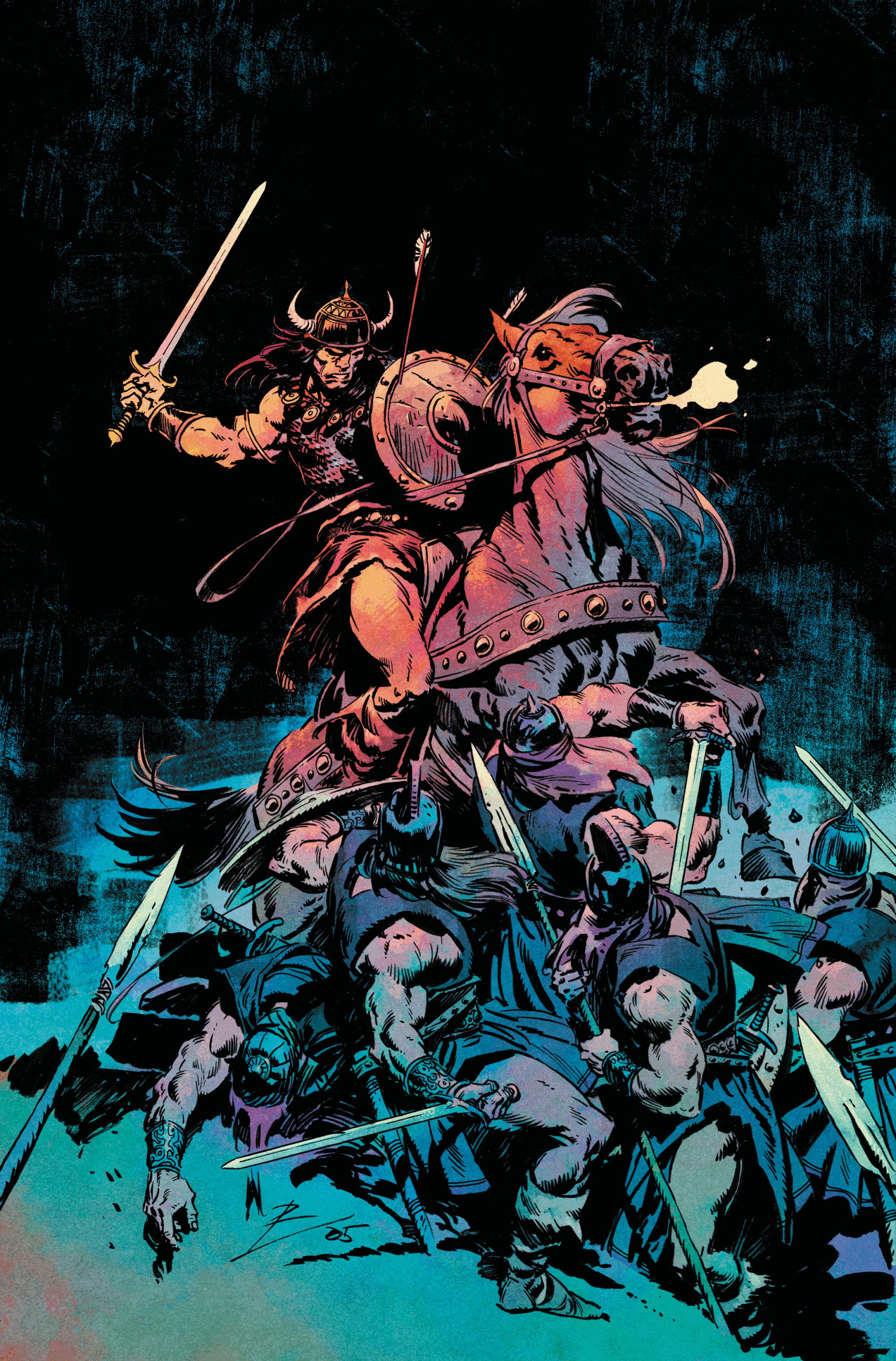
The documented count of languages under his command nears a dozen: Cimmerian, Aquilonian, Bossonian, Nordheimr, and Pictish from youth. Zamorian, Corinthian, Ophirean, Kothic, Shemitish, Hyrkanian, Argossean, and Kushite, most of which he acquired through travel.
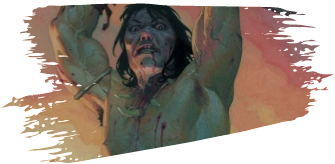
Of course, this makes sense the more you read from him. Conan was famously well spoken. When he was chained to a torturer’s wall in “The Scarlet Citadel”, Conan did not merely yell obscenities. He bellowed: “Free my hands and I’ll varnish this floor with your brains!” On whether the universe runs on magic or physics, from “Beyond the Black River” he says, “There’s nothing in the universe cold steel won’t cut. I threw my ax at the demon, and he took no hurt, but I might have missed in the dusk, or a branch deflected its flight.” When asked of his opinions of civilization itself in “The Tower of the Elephant”, Conan recoils with: “Civilized men are more discourteous than savages because they know they can be impolite without having their skulls split, as a general thing.” He could speak as any learned man could.
Conan’s ability to commune and even trounce his most educated colleagues is evidenced constantly throughout the original stories. Howard’s own first introduction of the character places him not behind a bloody weapon but seated at an ivory writing-table inlaid with gold, working with a stylus on an official map of his kingdom.
The common “nothing-but-a-brawler” frame doesn’t survive long either. In the story “Black Colossus,” Yasmela of Khoraja places Conan in command of her military. In return, he orchestrates a complex large-scale battle against the sorcerer Natohk using coordinated infantry-cavalry tactics. The civilized noblemen around him are depicted as tactical fools by comparison. Conan repeats this feat in “The Scarlet Citadel” and The Hour of the Dragon, when he stages massive campaigns as a brilliant general.

This breadth of experience is only possible because, across the twenty-two completed works of Conan the Barbarian, Howard traces a full life. The young Conan is a feral thief learning the corruptions of Zamora and Corinthia in “The Tower of the Elephant,” “The God in the Bowl,” and “Rogues in the House.” He becomes a seasoned mercenary leading free companies through Koth, Khoraja, and Turan in “Black Colossus,” “A Witch Shall Be Born,” and “Shadows in Zamboula.” He turns pirate and corsair in “Queen of the Black Coast” and “The Pool of the Black One,” mastering naval combat and earning the moniker Amra, or the Lion. He works as scout and general on the Aquilonian frontier in “Beyond the Black River.” And by “The Phoenix on the Sword,” “The Scarlet Citadel,” and The Hour of the Dragon, he is a weary king in his forties, governing a turbulent kingdom from a throne he no longer particularly wants.
It is just this simple: the basic, brutish character that most think is deserving to be dismissed is one that they’ve never actually met because he was never written that way.
The Silhouette
While the caricature of Conan may have fenced off the name from most popular tastes, it never fenced off the shape. The wandering swordsman at the edge of empire, the one who takes contracts in towns that distrust him and kills what needs killing before moving on, has been walking through your bookshelf and across your screens in different costumes.
Geralt of Rivia is Conan in white hair. He is a wandering swordsman with no homeland who takes contracts in towns that distrust him. He kills monsters for coin, and then he leaves. He lives in a world where civilization is a thin layer over older, hungrier things. Even the episodic rhythm of The Last Wish is structurally identical to how Conan worked in Weird Tales, moving from town to town with no overarching arc and no comfort at the end.
The Barbarian class at your D&D table is perhaps the cleanest analog. It is quite literally Conan with a character sheet stapled to him. Rage itself acts as a renewable resource and the ability to survive in the harsh wilderness is itself a class feature. Barbarians in D&D possess a deep distrust of arcane magic, just as Conan and his people did. They even prefer to use tactical weapons over spells! Perhaps all this is why Howard himself is listed by name in Appendix N of the 1979 Dungeon Master’s Guide.
Logen Ninefingers of The First Law grimdark book series is another clear nod to Conan. He is a feared northern barbarian, infamous for battle, who is dragged into civilized political schemes by men who fear him and use him as a weapon. Joe Abercrombie, the character’s creator, has called Logen a deconstruction of the noble barbarian archetype… but you cannot deconstruct a shape that doesn’t exist. It stands to reason that Logen only carries his tragic weight because the reader is already holding another silhouette – like Conan’s – in their head.
The pattern keeps going. Bronn of Game of Thrones is a low-born sellsword who outwits civilized lords through pragmatic violence. Sandor Clegane, too, is a brutalized warrior who walks away from the civilization that made him a monster. Gotrek the Dwarf Slayer and Felix Jaeger of the Warhammer series are practically shadows of Conan and his shieldmates moved to the Old World. Pick any swordsman in modern fantasy who walks alone, takes contracts, distrusts magic, and holds civilization in contempt, and it is hard not to notice the outline of Conan staring at you.
The point of all of this is that you don’t need to learn how to read or appreciate this character because you’ve been enjoying pieces of him for eighty years. You just didn’t know how to identify him but, trust us, even just one story will fix that.
Read One Story Tonight
If there is one thing you can do to tell whether or not Conan the Barbarian is for you, just read “The Tower of the Elephant”. It’s a completely free, 9,800 word story that’s readable in under forty-five minutes at average reading speed. It is frequently cited as the ideal entry point because it encapsulates the dual nature of Howard’s creation in a tight package.
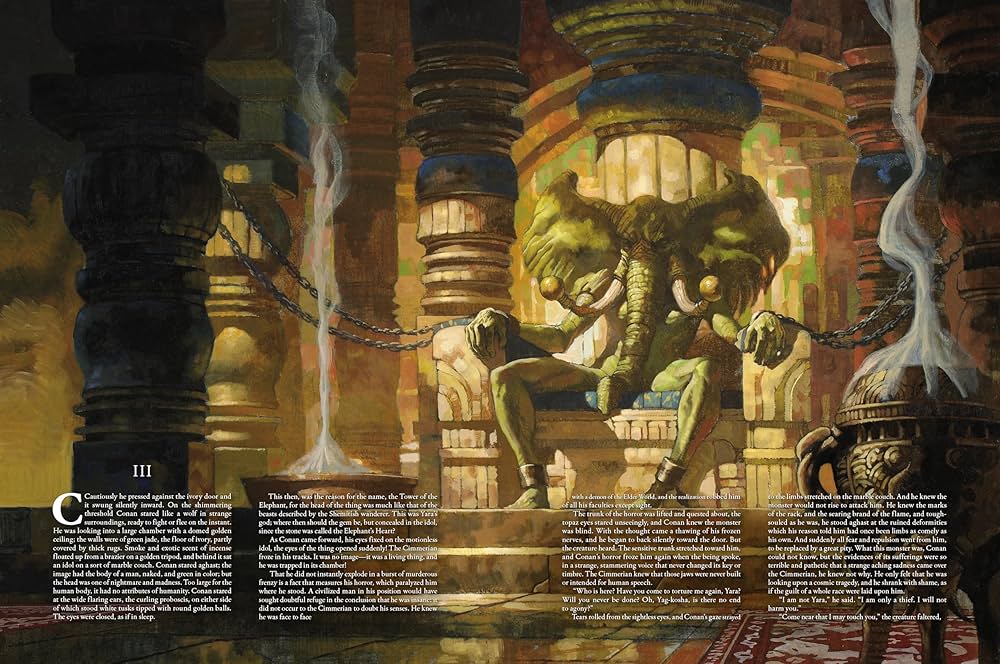
The premise, spoiler-free: a young, relatively inexperienced Conan has recently arrived in the corrupt Zamorian city of Arenjun, known as the “City of Thieves.” He overhears a tavern boast about an impenetrable, jewel-encrusted tower belonging to the feared sorcerer Yara. He decides to infiltrate it and steal a legendary gem.
The narrative executes a flawless genre shift. It opens as a kinetic heist and pivots, in the inner sanctum, from sword-and-sorcery into cosmic tragedy. The climax does not hinge on the sword arm but on Conan’s capacity for empathy and mercy. You’ll see just how quickly the “dumb brute” caricature dies.
Give it a read. You will know within five pages whether the things you thought you knew about Conan the Barbarian were lies.

Lo Terry
In his effort to help Heroic Signatures tell legendary stories, Lo Terry does a lot. Sometimes, that means spearheading an innovative, AI-driven tavern adventure. In others it means writing words in the voice of a mischievous merchant for people to chuckle at. It's a fun time.