



By now, you likely have heard the exciting news.
Titan Comics has endeavoured two heroes from two incompatible fantasy traditions–Robert E. Howard’s pulp sword-and-sorcery and Bonelli’s institutional high fantasy–to share a page for the first time in the new miniseries Conan and Dragonero.
What you may not have heard about is what it took to build that collision from the inside.
We spoke with Luca Enoch and Stefano Vietti, the co-creators who launched Dragonero as a graphic novel in 2007 and have spent nearly two decades expanding it into one of the biggest fantasy franchises in Italian comics.
What follows is what they told us about crashing their world into Howard’s and what both worlds revealed about themselves in the process.
The Dragon in the Room
The first thing Enoch and Vietti had to confront was the thing that makes this crossover possible and dangerous in equal measure: the dragon gap.
Howard’s Hyborian Age doesn’t have dragons. Not real ones. The closest thing Conan has ever faced is the reanimated saurian in Red Nails, which is more of a prehistoric horror instead of a winged, fire-breathing apex predator. Even the title of Howard’s only Conan novel, The Hour of the Dragon, uses the word as political metaphor, not creature description. In ninety years of publication history, the Cimmerian has never looked up and seen the thing that most fantasy readers picture when they hear the word.
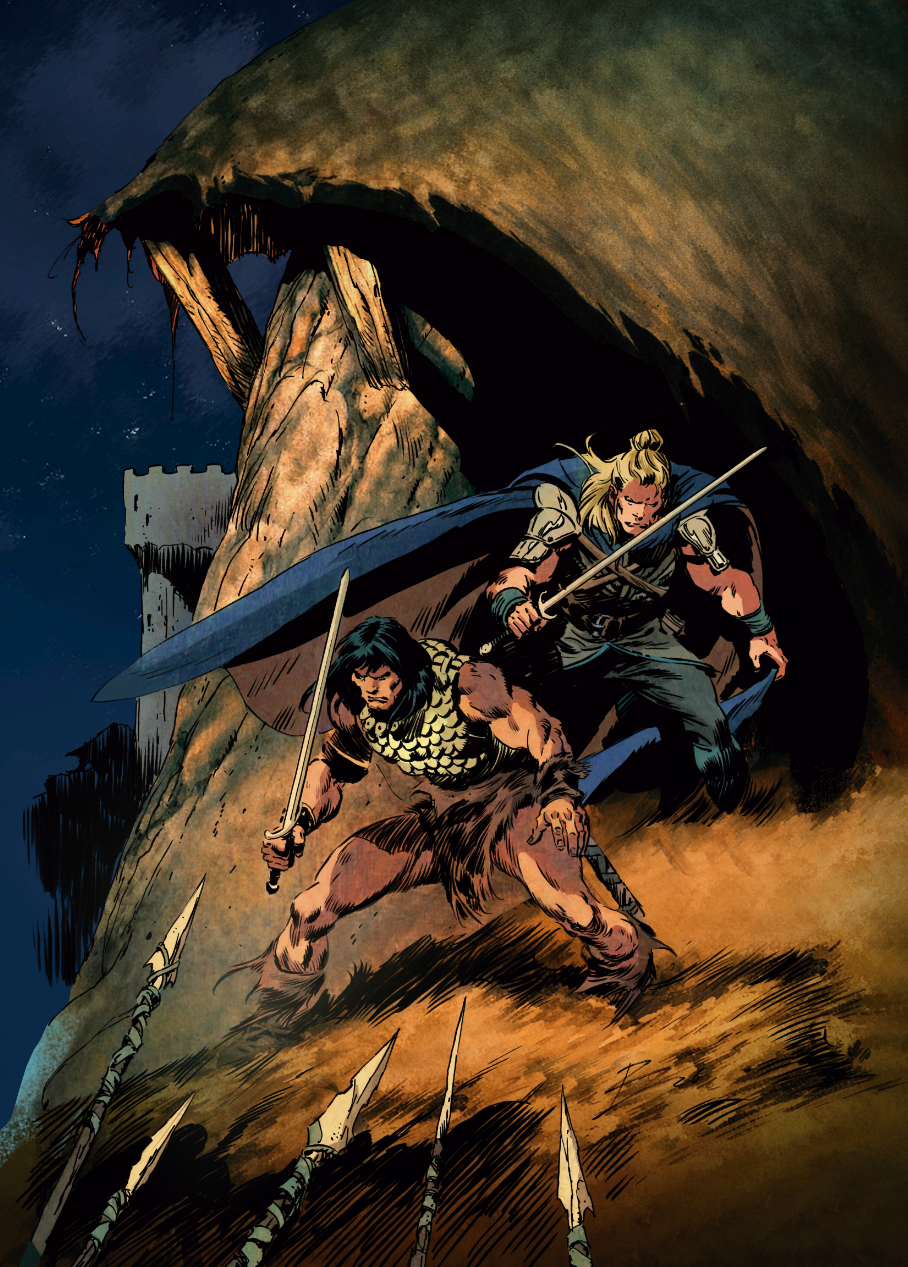
Enoch and Vietti knew this going in. More importantly, they didn’t treat it as a problem. “We were well aware of this difference between the bestiaries of the two worlds,” Enoch says, “and we used it as narrative fuel in the relationship between the two heroes.” Vietti puts it more simply: “It was a narrative spark to have Conan experience something entirely new.”
That instinct to treat the gap between the two worlds as an engine rather than an obstacle runs through every creative decision in this crossover.
Two Theories of Magic
The dragon gap is really a symptom of a deeper incompatibility: Howard and Dragonero don’t agree on what magic is.
In the Hyborian Age, magic is corruption. It costs the user something essential like their sanity, humanity, or the ability to walk in daylight without flinching. Howard’s sorcerers are almost universally villains because the act of wielding magic is itself a moral catastrophe. If it doesn’t destroy you, you weren’t really doing it.
Dragonero’s magic operates on an entirely different principle. “Magic in Dragonero is the glue that holds together the physical world,” Enoch explains. The spirits of the dead flow into a universal reservoir called the khame, and from that reservoir, a class of guardians called the Luresindi draw power. It’s institutional, regulated, and fundamentally positive
But Vietti is quick to note the seam where the two traditions meet: “There are ancient corrupted relics that grant dark powers to necromancers, and this is a magical aspect closer to Conan’s world.” That seam is where the crossover lives: in the narrow band where Dragonero’s orderly magic and Howard’s feral sorcery overlap just enough to share a story.
What a Dragon Actually Is
If you’re coming to Dragonero from Conan, the single most important thing to understand is what dragons mean in Erondár because they mean something far stranger than “big monster with wings.”
Dragons in Erondár are the oldest living things. They are sentient, bound together in a spiritual network they call the “Mother Souls,” and they are the architects of natural magic itself. “They were the world’s first inhabitants,” Enoch says, “those who created natural magic and shaped the world as we know it.” They fought alongside humans and elves in an ancient war against subterranean horrors, then voluntarily withdrew to a distant land no one else can reach.
The ones who refused to leave, known as the Renegades, are the reason Ian Aranill’s bloodline exists. The Varliedarto, literally “dragon conquerors” in Dragonero’s constructed Elder Speech, were founded specifically to hunt these dissidents. The Great Dragons gave the first Varliedarto their own blood to drink before departing, a gift that passed through generations. Ian inherited that blood. Then, during a fight with a Renegade, he accidentally swallowed the live blood of the dragon he killed. “Like Sigurd with the dragon Fafnir,” Enoch says, Ian “emerges transformed and with latent powers.”
This is why the crossover has stakes beyond spectacle. Ian is, at a biological and spiritual level, made of dragon. Everything that makes him formidable is downstream of the thing he hunts. Only, now, he has to figure out how to wield that framework into a world where none of it applies.
An Empire That Feels Governed
One of the things that separates Dragonero from most post-Tolkien fantasy is that its empire actually feels like it’s being run by somebody.
Erondár is a genuine a political body with institutional logic, built on ancient bones: “A vast empire that resembles the Roman Empire at its height. A vast wall to the northwest separates the civilized lands from the wild lands of the nomadic Algenti, similar to Hadrian’s Wall or the Great Wall of China.”
But he diverged from Rome in one critical respect. “Unlike the Roman Empire, which welcomed every foreign cult and celebrated it in its Pantheon, the Erondarian Empire scorched every local religion, imposing its own.” The reason is cosmological: in Dragonero’s world, gods become powerful in direct proportion to their number of worshippers. That single detail means every temple is a power plant, every heresy is an act of war, and every conquered province that keeps praying to its old gods is an existential threat wearing a civilian face.
Vietti adds the physical layer: “We traveled extensively across many Italian regions at the beginning of the project, taking photos of castles, fortresses, towers, and ancient villages, trying to capture every small detail that could help the illustrators. Living in Italy gave us not a few advantages: wherever you go, there are still vivid testimonies from ancient Rome to the Middle Ages.”
Fantasy Beyond the Anglo-Saxon Default
This is the part of the conversation where it becomes clear that Dragonero isn’t just “Italian Tolkien.” It’s something more specific than that.
“Although we started from the same foundations of Anglo-Saxon fantasy like the Norse sagas, the Nordic myths, the Nibelungenlied,” Enoch says, “we had all our Greco-Roman epic culture to draw on, our Italian history and that of distant countries, different from Northern Europe, like China and Japan.”
Most English-language fantasy readers have never encountered a major fantasy world built from Mediterranean and East Asian foundations rather than Northern European ones. The elves and dwarves are there, but the political architecture, the visual language, the way institutions behave, is all running on different source code. Vietti describes it as deliberate: “Our Erondár is divided into territories that highlight these differences, both in architectural elements and in cultural ones.”
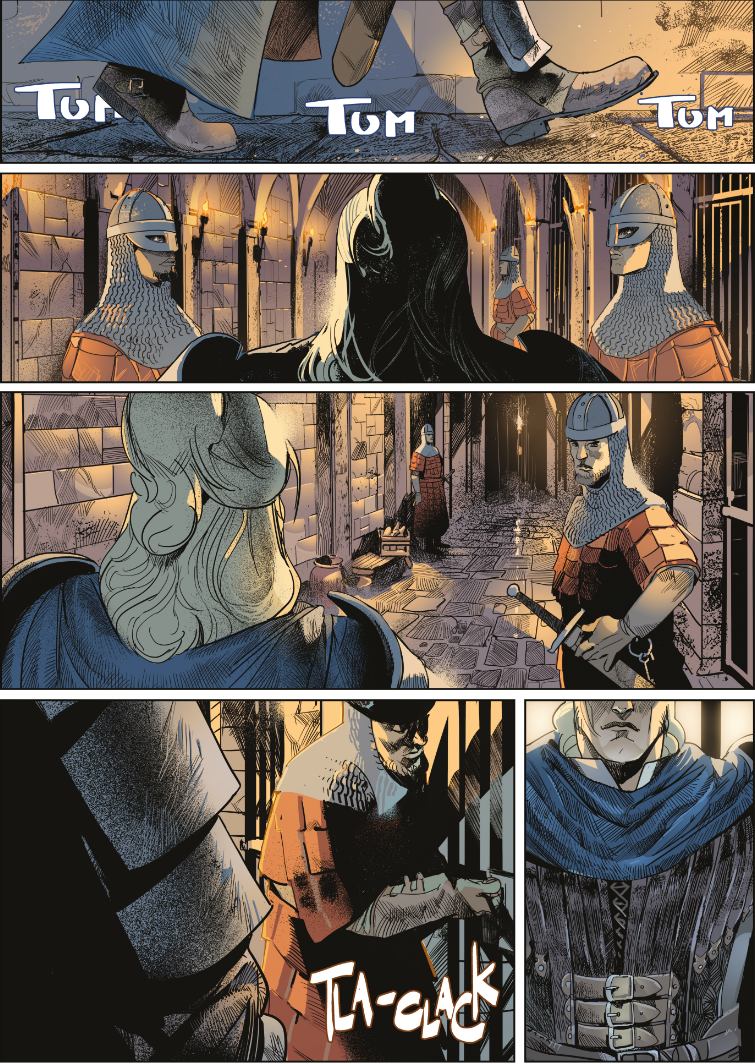
For Howard readers specifically, this matters. Howard himself was restless with trying to crane his neck away from the Anglo-Saxon default. He wanted his fantasy to feel like the whole world, not just the north of it. Dragonero is building from a similar impulse, just from the other side of the Alps.
The Beautiful Explosion
So what actually happens when you put these two characters in a room?
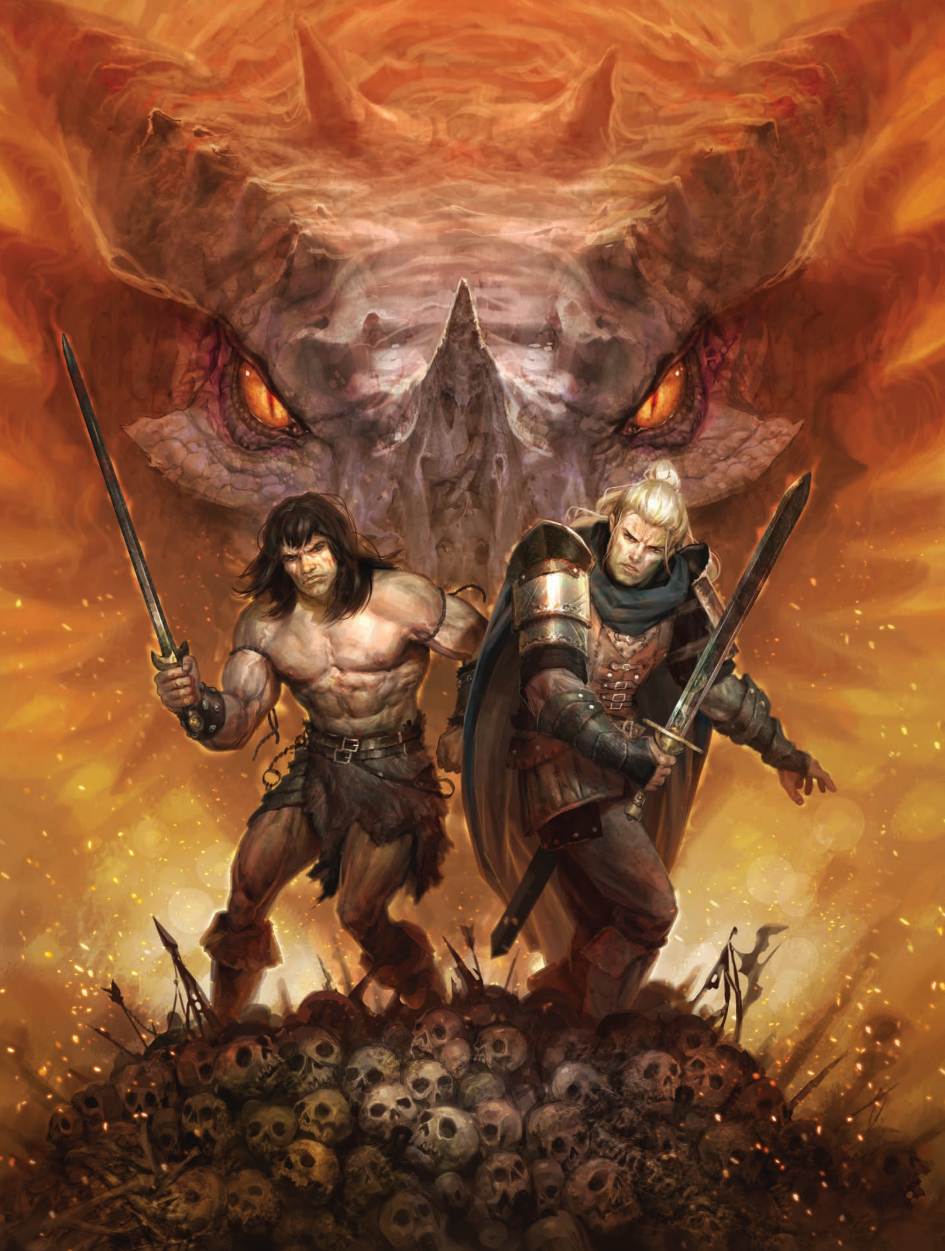
“The likely result when two reactive chemical elements mix is usually a beautiful explosion,” Enoch says. “Between two such strong and different personalities, there can only be a strong initial contrast. But, since both are ‘righteous’ heroes, faced with a common challenge, collaboration is inevitable.”
The key creative challenge was balancing two fundamentally different power scales. Sword-and-sorcery keeps its heroes mortal and its magic monstrous. High fantasy gives its heroes more tools, more infrastructure, more institutional support. Put the two in the same story and you risk either nerfing the high-fantasy character or making the sword-and-sorcery one irrelevant.
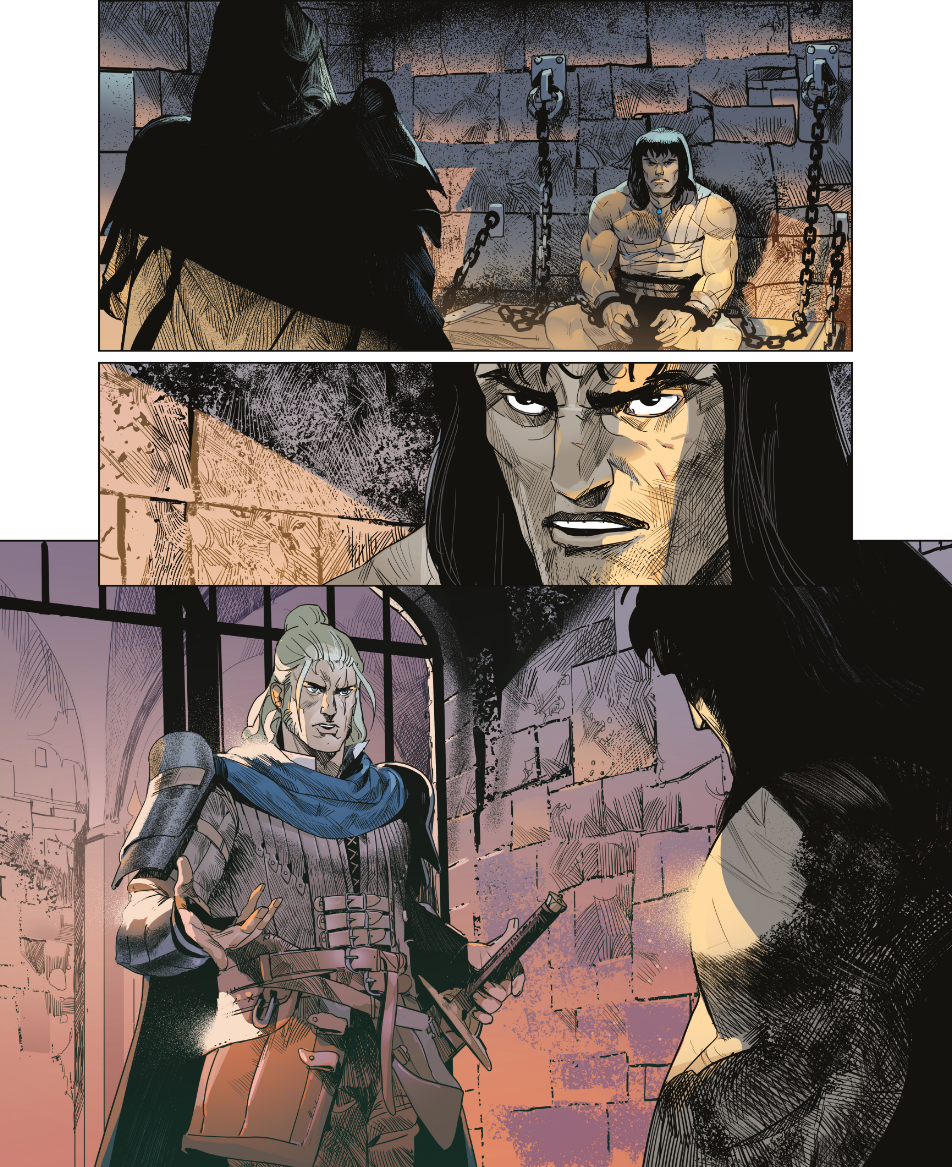
Enoch and Vietti’s solution was elegant: they built the crossover around each character’s weaknesses “Conan is impetuous, disinclined to reason, and resistant to magic–and fears it,” Enoch says. “Ian is more thoughtful; magic surrounds and permeates him, and his relationship with his sword, which harbors the spirits of slain dragons, sometimes makes him vulnerable. Each hero helps the other overcome their own vulnerabilities.”
Vietti finds humor in one specific consequence: “I still remember that at a certain point in the story, Conan’s incredible physical strength got us out of trouble in a way we weren’t used to with Dragonero.” When you’ve spent nearly two decades writing a character who solves problems through institutional scaffolding and magical infrastructure, there’s something liberating about having a barbarian just punch through the wall.
What Each Man Stands to Lose
The crossover’s mechanism is straightforward: dragons in Erondár can move between planes of existence, and the heroes use them as vectors to cross from one world to the other. Clean. Simple. But what makes it matter is what each character loses in transit.
Drop Conan into Erondár, and his entire operating system breaks. “His physical strength and exuberant courage could no longer be an advantage but a liability,” Enoch says. This is a world shaped by magic, where magical acts aren’t the exclusive domain of necromancers but the ambient condition of reality. Conan’s instinctive distrust of sorcery thus becomes a handicap in a world where magic is the air you breathe.
Ian pays the inverse toll. Strand him in Hyboria, a world stripped of the khame, empty of the Mother Souls, and devoid of the institutional lattice that gives Erondár its structure, and he loses the latent powers that surface when he needs them most. He’s still a trained fighter. He still carries the sword. But the spiritual infrastructure that makes him Dragonero simply doesn’t exist in Howard’s world.
Both men are at their most dangerous at home and their most vulnerable abroad, and the story puts them in both positions.
The Scene That Sells It
When we asked Enoch and Vietti to name the single scene in this crossover that an English-language reader should use as their litmus test, they each picked a different one.
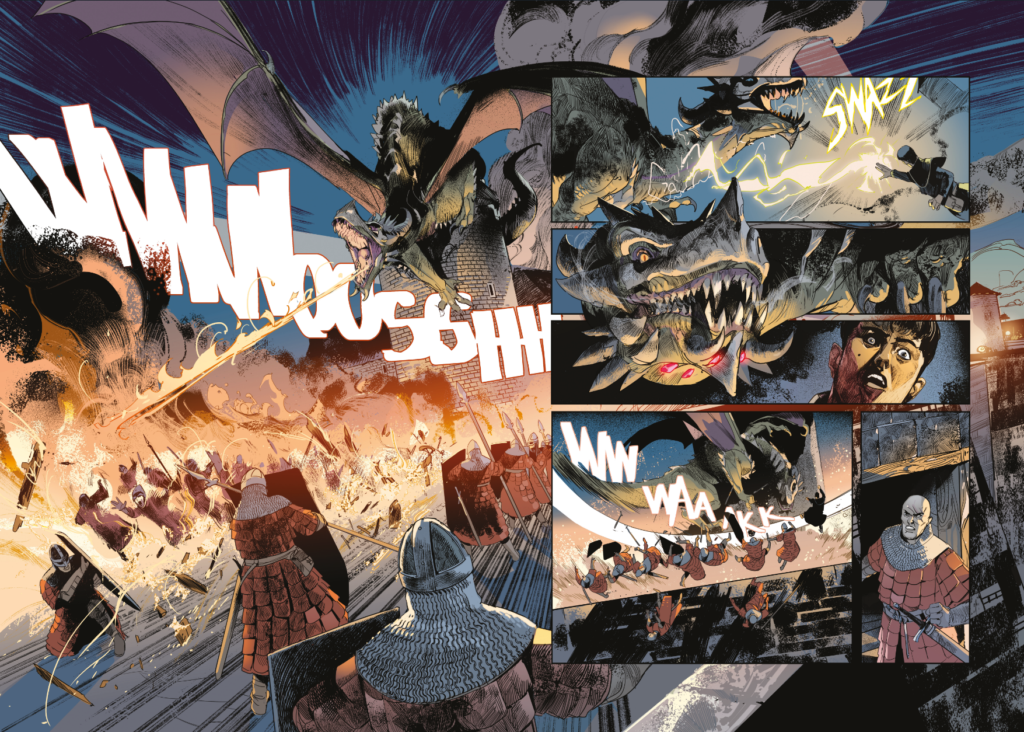
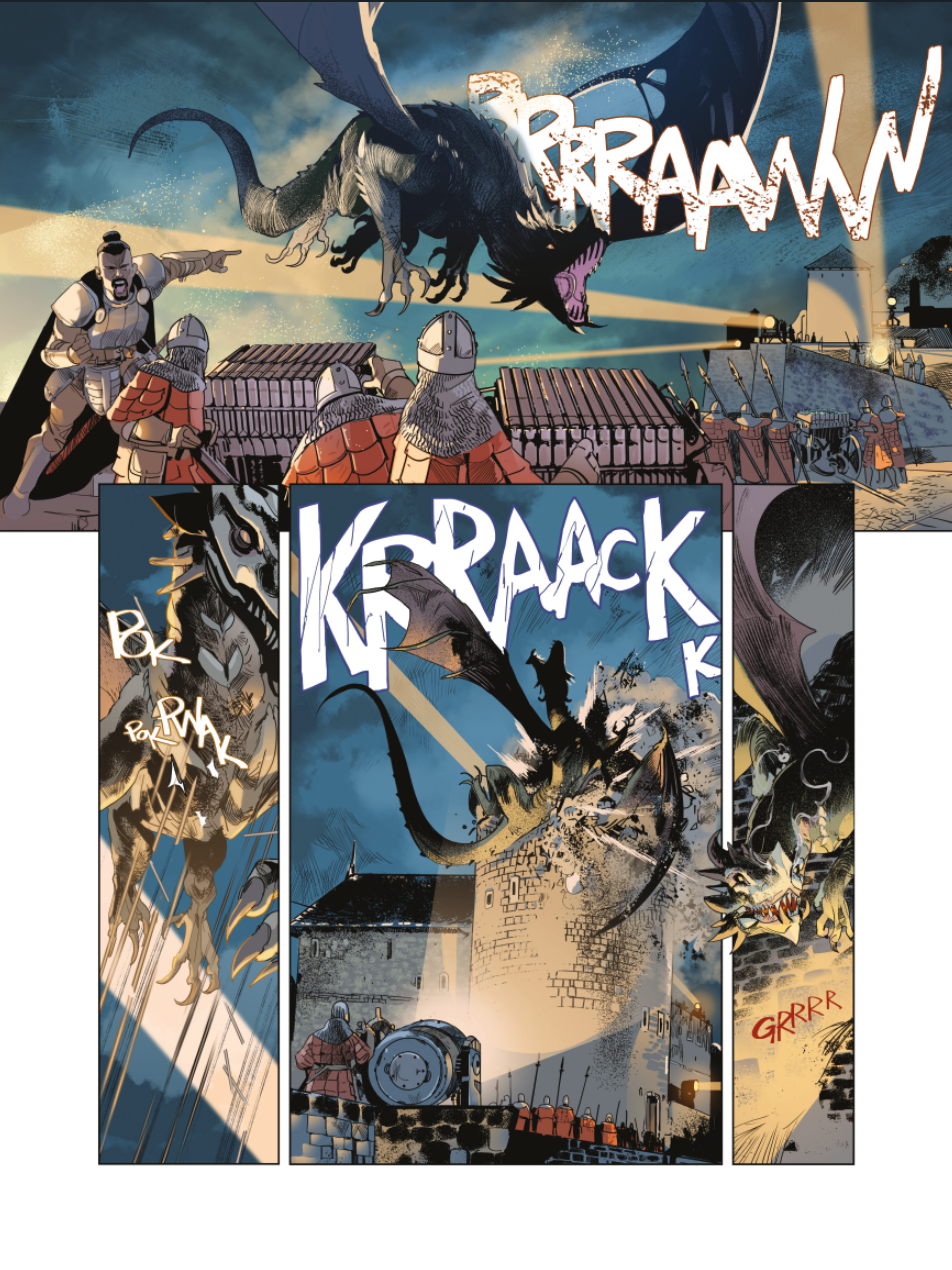
Enoch pointed to the dragon’s attack on the Red Guard-defended Wall, and the wild wyverns’ assault on a Technocrat airship taking flight over the mountains. Scale, chaos, and two fantasy traditions crashing together in a single set piece.
Vietti chose the battle between Conan, Ian, and the Dragon, which he described as “a truly well-executed and powerful scene” that delivers exactly what the crossover promises: two heroes, two traditions, one fight that neither could win alone.
Conan and Dragonero #1 has arrived. Get it now.

Lo Terry
In his effort to help Heroic Signatures tell legendary stories, Lo Terry does a lot. Sometimes, that means spearheading an innovative, AI-driven tavern adventure. In others it means writing words in the voice of a mischievous merchant for people to chuckle at. It's a fun time.